Play at 18 Months: What Actually Fills a Morning
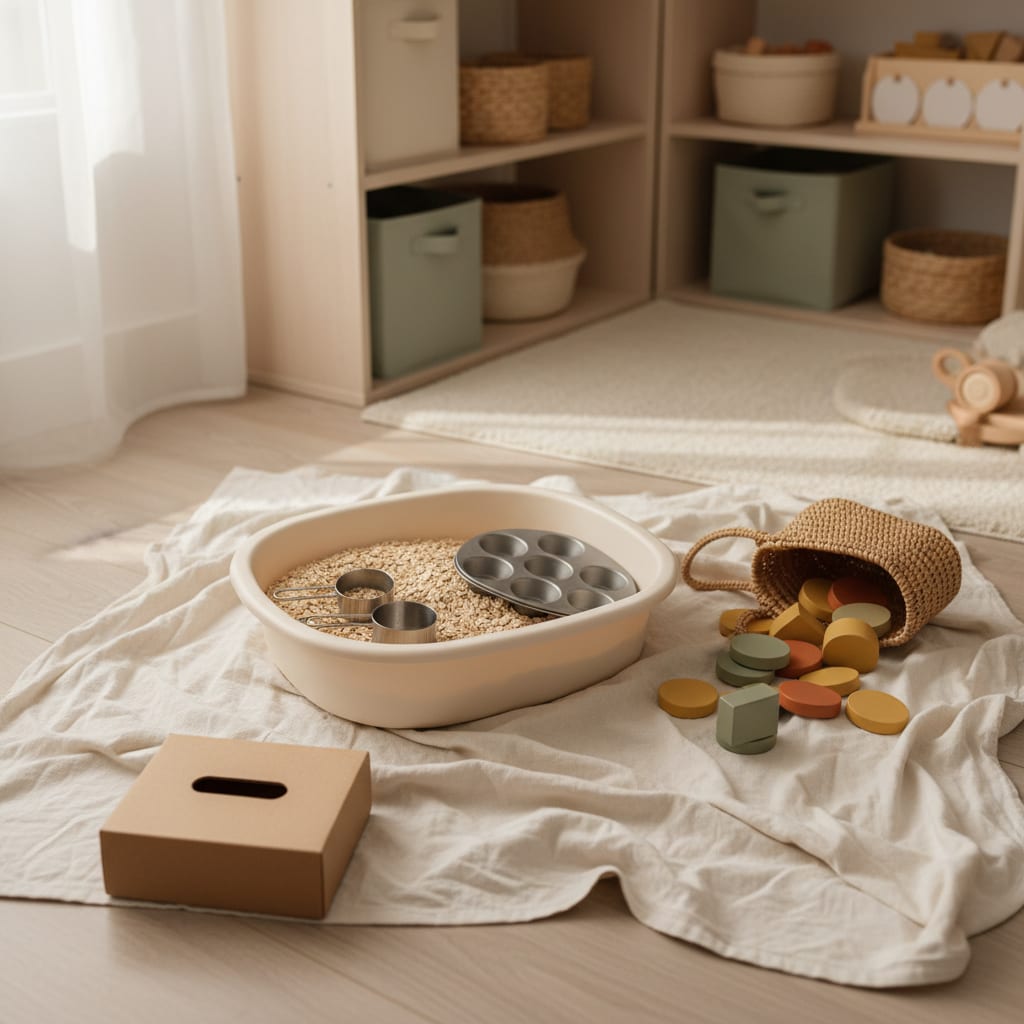
Play at 18 months is not crafts, games, or anything with steps — it’s dumping, filling, transferring, carrying, and doing the same thing forty times in a row. Once you accept that, filling a morning gets easy: set up two or three transfer-and-dump stations from stuff you already own, run the biggest one as the mid-morning centerpiece, and let repetition do the heavy lifting. A muffin tin, a bin of oats, and a set of measuring cups will outperform any activity kit at this age, because they match what an 18-month-old’s brain is actually working on.
What 18-month play actually looks like
If you watch an 18-month-old play without an agenda, you’ll see the same handful of moves on loop: put things in, dump things out, carry things across the room, hand things to you, repeat. In classroom language these are schemas — the transporting phase, the enveloping phase — but the practical takeaway is simpler: the repetitive thing your toddler is obsessed with IS the play. It’s not a warm-up for real play. There is no other play coming.
This reframe is what makes the morning fillable. You stop hunting for activities interesting enough to compete with dumping, and start building better dumping.
The morning arc with an 18-month-old
Mornings at this age have a shape, and working with it beats fighting it. Ours ran — and I’ve heard a hundred versions of the same arc — roughly like this:
- After breakfast: warm-up. Low-stakes, self-serve play while you reset the kitchen — the sanctioned tupperware cupboard, a basket of board books, the play shelf. This is also prime practice time for independent play, because everyone’s fed and fresh.
- Mid-morning: the centerpiece. The one setup that costs you something and pays real minutes — the big bin, water play, or the outing. At 18 months this block is shorter than the Pinterest fantasy; fifteen to twenty-five absorbed minutes is a genuinely good run.
- Pre-lunch drift: kitchen-adjacent. Transfer stations near your feet while lunch happens. Then lunch, then the nap ramp — where this block lands in the two-nap or one-nap day depends on which side of the nap transition you’re on.
The setups that actually work (all fifteen seconds)
The oat bin. A shallow tub of rolled oats, measuring cups, a muffin tin. This is the entry-level sensory bin for the mouthing age — taste-safe, sweepable, endlessly transferable. Sit them on a bedsheet, accept that some oats are a floor tax, done.
Water, tiny format. An inch of water in a baking dish on a beach towel, two cups, a spoon. Whole setup is a faucet away, and pouring practice is the 18-month equivalent of a treadmill.
The transporting station. A small bag, basket, or toy stroller plus a pile of anything — blocks, balls, clean socks. They will load, haul, dump, and reload across the living room until you get bored, which is long after they do not.
The posting box. A slot cut in a shoebox lid plus something satisfying to post: jar lids, large pom-poms, wooden coins. In-and-out is the whole game; the slot just makes it clickier.
The muffin-tin sorter. A muffin tin and one thing per cup to move, swap, and rearrange — big pom-poms, duplo bricks, the measuring-cup lids. Zero rules. They invent the sorting themselves eventually.
The low kitchen drawer. One drawer that’s theirs: whisks, silicone spatulas, containers with lids. It refills the pre-lunch drift every single day for free.
What doesn’t work yet (skip the guilt)
Crafts with an outcome, anything requiring turn-taking, puzzles beyond the chunky-peg kind, coloring for more than ninety seconds, and any activity where the point is the product — all of it lands somewhere between “eaten” and “thrown.” That’s not your kid being behind; it’s the wrong developmental aisle. The craft years come. At 18 months, process is everything and the process is dumping.
One real caveat: this is peak mouthing age, so everything above is sized and chosen to be taste-safe or too big to swallow — oats instead of rice if your kid still samples the merchandise, pom-poms only the jumbo size, and you within arm’s reach for anything borderline. When in doubt, ask your pediatrician, not the internet.
The rotation is the secret
None of these setups survives daily use — but all of them survive weekly use, forever. Run two or three in the lineup, swap when the centerpiece stops holding attention, bring retired setups back after a couple of weeks and watch them land like new. A five-setup roster on rotation fills more mornings than a fifty-idea list you never open, which is the whole system-over-list philosophy this site runs on.
FAQ: play at 18 months
How long should an 18 month old play with one activity?
Short runs are normal: five to fifteen minutes for most setups, with a good centerpiece sometimes stretching to twenty-plus. Expect the morning to be a chain of short engagements, not one long one — that’s typical attention span at this age, not a problem.
What can I do with my 18 month old all morning?
Run the arc: self-serve warm-up play after breakfast, one bigger centerpiece setup mid-morning (bin, water, or an outing), then kitchen-adjacent transfer play before lunch. Two or three fifteen-second setups on rotation cover it — you don’t need a new idea every day.
Do I need special toys or kits for an 18 month old?
No. The best play at this age is containers, things that fit in containers, water, oats, and household objects. A few open-ended toys (blocks, cups, a couple of animals) round it out. Subscription kits aren’t harmful — they’re just mostly things you already own, rearranged.
Should I be playing with my toddler the whole time?
No — a mix is healthier for both of you. Be fully in for setup and the first minutes, then step to the edge and let them run it. Independent play is a skill worth building on purpose, and mornings are the easiest place to practice it.