Sensory Bin Ideas by Age (and What to Fill Them With)
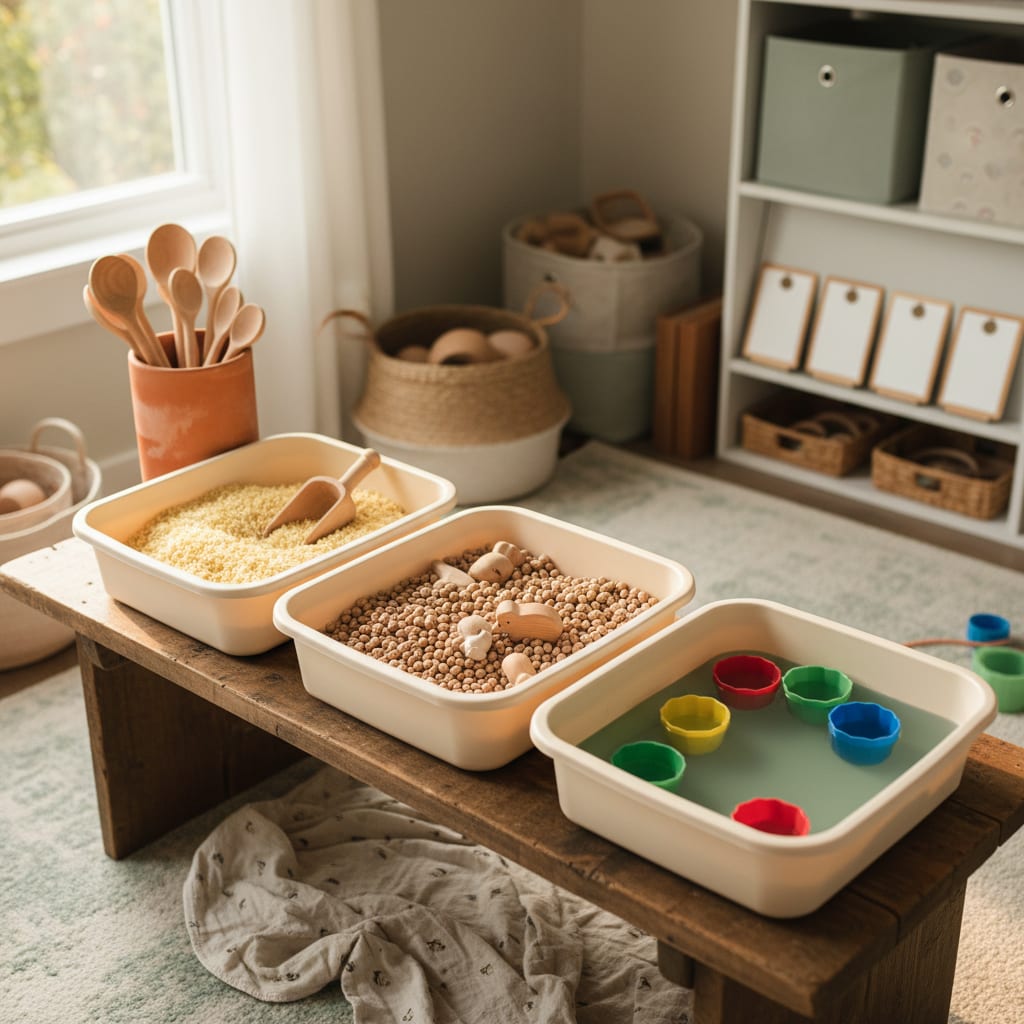
A sensory bin is just a shallow tub, a dry or wet base (rice, oats, water, kinetic sand), a few scooping tools, and something to find buried inside. That’s it — the magic is in the rotation, not the recipe. Instead of building a new Pinterest project every morning, keep three bins made up at once and cycle one into the morning play block each day. Below are the bases and tools worth owning, bin ideas by age from about one year to four, and the three-bin rotation system that makes the whole thing run itself.
Why a rotation beats a Pinterest board
In my preschool classroom, the sensory table wasn’t a special event — it was furniture. It got refilled on a schedule, not reinvented daily, and the kids played harder because it was familiar. Novelty gets attention for four minutes; familiarity-with-a-twist gets thirty.
At home, that principle becomes the bin rotation: same tub, same spot in the morning play block, contents that change about weekly. My kids don’t ask “what is this” anymore — they ask “what’s in it today,” and then they get to work. The bin has a job in our day: it comes out after the breakfast reset, buys me a genuine half hour, and is packed away before the nap ramp. If your day doesn’t have blocks like that yet, start with building your day around naps — a bin fills a block beautifully, but it can’t create one.
The anatomy of a bin
Every bin is three layers. Once you own the parts, “making a sensory bin” takes about ninety seconds.
- The base — the stuff that fills the tub. Dry pantry bases are the workhorses: rice (dyed or plain), rolled oats, dried pasta, dried beans or chickpeas, cornmeal. Beyond the pantry: kinetic sand, water beads (older kids only — they’re a choking hazard for mouthers), shredded paper, cotton balls, plain water. You need maybe three bases in your cupboard, not thirty.
- The tools — scoops, cups, funnels, spoons, tongs, a small pitcher. Raid the kitchen drawer before buying anything; a muffin tin parked next to the bin doubles play time all by itself.
- The hideables — the treasure. Toy animals, big buttons, pom-poms, wooden letters, duplicate blocks, cookie cutters. Bury ten things, hand over a scoop, and you’ve invented archaeology.
One honest note: the tub matters more than you’d think. A shallow, wide under-bed storage box beats a deep bucket — little arms can reach everything, and spills stay in scoop range instead of avalanche range.
Bin ideas by age
Around 12–18 months: taste-safe everything
At this age, everything goes in the mouth, so build bins where that’s fine: dry oats with metal spoons and a muffin tin, cooked spaghetti, yogurt “paint” on the highchair tray, or a water bin with cups on a towel. Skip small hard bases like beans and anything that swells (water beads are a hard no). Sit with them the whole time — at this age the bin is a together-activity, not a coffee break. If you’re unsure whether a filler is safe for your particular mouther, that’s a pediatrician question, not a blog question.
Around 18 months–2.5 years: the scoop-and-dump era
This is peak bin age. Rice or oats with funnels and cups, a “car wash” bin (toy cars, soapy water, a toothbrush), dried pasta with tongs and an ice cube tray, a dig site with beans and buried animals. Mouthing fades through this window but supervision doesn’t — stay in the room, keep the bin on a floor sheet, and teach the one rule that saves the whole enterprise: the filler stays in the tub. (Enforced calmly, about four hundred times. It does eventually stick.)
Around 3–4 years: bins with a storyline
Preschoolers want scenarios, not just textures. A construction site (kinetic sand, diggers, pebbles), an ocean rescue (water, blue food coloring, sea animals, a net), a “soup kitchen” (water, herbs from the garden, ladles and pots), letter digs where they match wooden letters to a card. At this age the bin genuinely buys you the thirty-to-forty-five-minute stretch — this is when it becomes the anchor activity of the morning block.
The three-bin rotation system
Here’s the system that turns all of the above from ideas into a rhythm:
- Own three lidded tubs. One lives in the play space; two live stacked in a closet, made up and ready.
- One bin per morning. It comes out at the same point in the rhythm every day — after the breakfast reset works best, when energy is high and patience (yours) still exists.
- Rotate weekly-ish. Every week or so, the current bin goes to the back of the line and the next one comes out. Familiar bins returning after two weeks away play like new ones.
- Refresh one element, not everything. When a bin comes back into rotation, swap just the hideables or just the tools. New treasure in old rice is a new bin as far as a toddler is concerned.
- Retire seasonally. A full base swap four-ish times a year is plenty. This is a system measured in minutes per month, not hours per week.
The point of the system is what it deletes: the 7am scramble for an activity, the guilt about not being crafty, and the graveyard of single-use Pinterest projects. One tub of rice, rotated well, genuinely outperforms a month of elaborate setups.
FAQ: sensory bins at home
What age can toddlers start sensory bins?
Most kids can start supervised, taste-safe bins around their first birthday — think oats, water play, or cooked pasta. Save small, hard fillers like beans and rice for when mouthing has clearly faded, and ask your pediatrician if you’re not sure where your child is on that curve.
How long will a toddler actually play with one?
Expect five to ten minutes at first — bin stamina is learned. With a consistent spot in the daily rhythm and a parent nearby but not directing, most two-year-olds work up to twenty or thirty minutes within a few weeks. The rotation is what builds the stamina: familiar bin, fresh twist.
What’s the cheapest way to start?
A shallow storage tub, a bag of rice or oats from the pantry, kitchen scoops, and whatever small toys you already own. That’s the whole starter kit — roughly the cost of a bag of rice if the tub’s already in the house. Buy nothing else until the habit sticks.
How do I handle the mess?
Put a fitted sheet or shower curtain under the bin, keep a hand broom clipped to the shelf, and make sweep-up part of the activity (“filler back in the tub” is a game if you sell it right). And do messy bases outside in summer — the backyard forgives everything.