Toy Rotation: The Play Shelf That Runs Your Morning
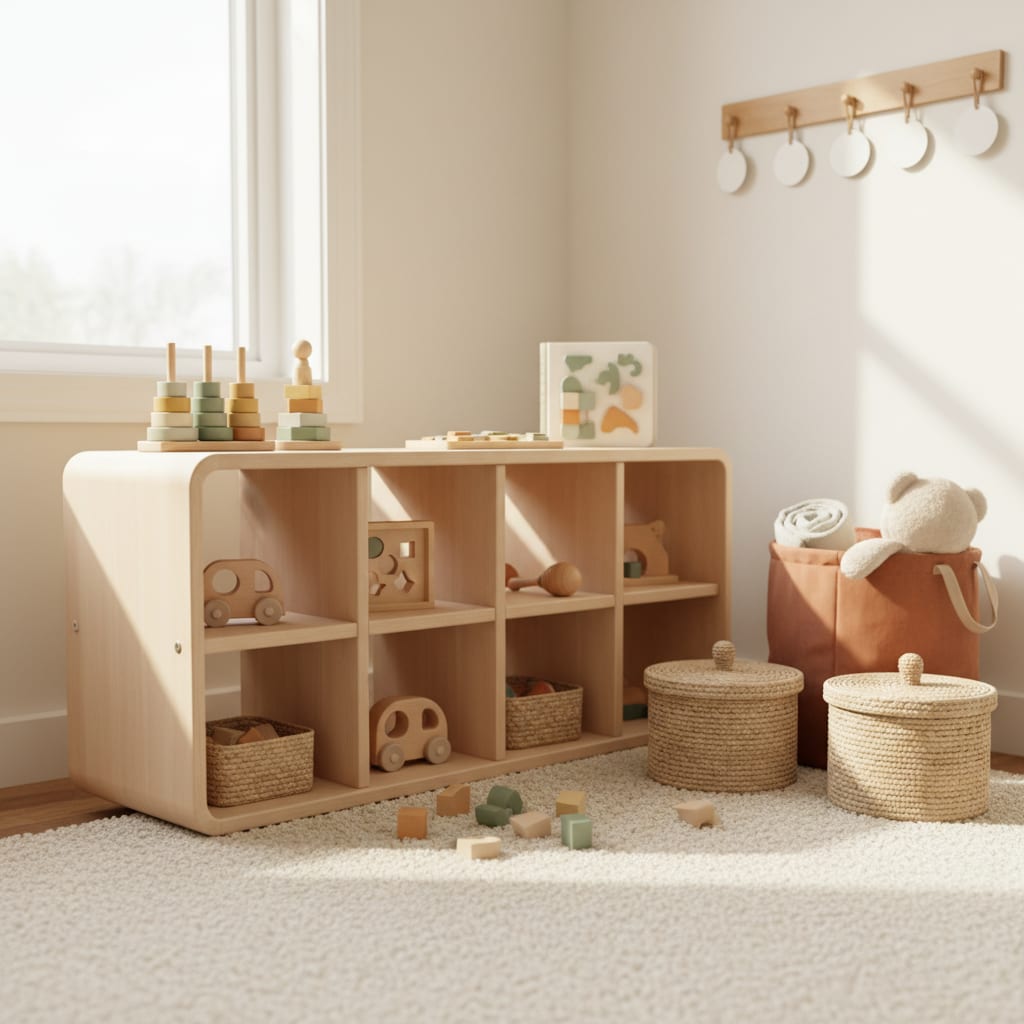
Toy rotation means most of the toys live in storage and only a small, curated set — call it six to ten choices — is out on a low shelf at any time, with the sets swapped every week or two. The payoff is the one every stay-at-home mom actually wants: kids play longer and deeper with less, the floor stops being a landfill, and the morning block starts itself because the shelf looks new without you buying anything. Here’s the system that has run our playroom for two years, in classroom-teacher form: small, boring, and nearly impossible to fall off of.
Why fewer toys out means more play
Every preschool teacher learns this in week one: a room with everything out produces dumping, not playing. A toddler facing forty options grabs, discards, grabs, discards — the choosing overwhelms the playing. Shrink the field to a handful of good options with space around each one, and the same kid settles into one thing and goes deep. You’ve probably watched this happen in reverse at your house: the birthday-aftermath week when the playroom was fullest and the playing was worst.
Rotation is just that classroom principle, systematized. It’s also the engine behind independent play — a shelf a toddler can see, reach, and choose from is a morning that runs itself for stretches, which is the whole reason this site cares about a toy storage strategy at all. The shelf isn’t decor. It’s infrastructure for the big block of the day.
The setup: one shelf, three bins, fifteen minutes
You don’t need new furniture and you definitely don’t need new toys. You need:
A low, open shelf. Whatever you own that’s toddler-height works. The rule is display, not storage: each toy or set sits alone in its spot, visible, front-facing. A bin of jumbled toys on a shelf is not rotation; it’s a smaller landfill.
Six to ten things out. Aim for a spread across types rather than a theme: something to build (blocks, magnetic tiles), something to pretend with (animals, play food, dolls), something with wheels, something for hands (puzzle, shape sorter, lacing), something creative (crayons and paper live out permanently at our house), and one book basket. Two kids at different ages? Split the shelf — her stuff on top rows, his on the bottom — and let the overlap happen, because it will.
Everything else in closed bins, out of sight. Ours live on a closet shelf in three loosely-sorted tubs. Out of sight is the active ingredient — a visible pile of off-duty toys just becomes a negotiation. Nobody mourns what they can’t see; the toy that comes back after three weeks away is genuinely new again.
The first sort takes one naptime. While you’re in there, run the classroom cull: broken things, sets missing their critical pieces, and the noisy thing you’ve always hated can quietly exit. Rotation season is amnesty season.
The cadence: swap on signal, not on schedule
Every rotation guide online prescribes a cadence — weekly, biweekly — and every real household drifts off it, feels behind, and quits. So skip the calendar. Swap when the shelf tells you: the dumping-instead-of-playing comes back, the same two toys have carried a week while the rest sit untouched, or the morning block suddenly needs you every four minutes. That’s the shelf going stale, and it takes about ninety seconds to fix — pull the ignored items, bring out replacements from the bins, reset the spots. I do it after bedtime and let the “new” shelf be the morning’s opening event.
Two refinements that earn their keep:
- Keep anchors out. Every kid has one or two loves that never rotate — the trucks, the baby doll. Rotating a lovey-adjacent toy buys you nothing but grief. The system applies to the middle of the roster, not the stars.
- Rotate to the season and the week. Rain in the forecast? Surface the density: magnetic tiles, the big animal bin, play dough. The sensory bin rotation runs on the same logic as a parallel track — one bin out, the rest waiting — and together the two systems basically stock the morning block for free.
What rotation doesn’t fix
Honesty section. Rotation will not make a two-year-old play alone for an hour (nothing does), it won’t survive a sibling determined to dump every bin (gates and closed closets are part of the system), and the first week may be bumpy while kids look for vanished toys — answer cheerfully that they’re “resting” and hold the line. It also doesn’t require aesthetic shelves, wooden-only toys, or any particular philosophy. It’s not a look; it’s a queue. Plastic dinosaurs rotate exactly as well as the beautiful stuff.
What it reliably does: longer play stretches, a floor you can cross barefoot, fewer toys purchased (the bins are full of “new” toys already), and a morning that starts without you performing entertainment. For a home-days operating system, that’s the whole wish list.
FAQ: toy rotation
How many toys should be out at once?
Six to ten choices displayed with space around each works for most toddlers — fewer for younger kids, slightly more for mixed ages sharing a space. The test isn’t the count, it’s the behavior: settled, longer play means the number is right; grab-and-dump means too many or too stale.
How often should I rotate toys?
Whenever play goes shallow — usually every one to three weeks in practice. Swapping on that signal beats a fixed schedule you’ll drift from. The swap itself takes a couple of minutes in the evening, and a “new” shelf makes the next morning noticeably easier.
Do I rotate books too?
Lightly. Keep a small basket of eight or so out and swap most of it when you rotate toys, but leave the current favorites alone — repetition is how toddlers love books, and the seventy-fifth read is a feature. A library-trip cycle rotates books for free.
What about toys my kid asks for from storage?
Hand them over — the point is a calmer shelf, not a locked archive. A requested toy is a toy that still has juice; swap it onto the shelf in place of something ignored. If one bin gets requested constantly, that’s your kid telling you what next rotation should feature.