Toddler Morning Routine That Ends the Battles
A toddler morning routine that actually ends the battles is an event chain: the same five or six steps in the same order every single day — wake, milk-and-cuddle, breakfast, get dressed, teeth, play — with each step cueing the next, no clock involved. Toddlers don’t fight routines; they fight surprises and interruptions. When the morning runs in an order older than their memory, there’s nothing to negotiate — after breakfast comes getting dressed the way after night comes morning. Here’s how to build the chain, our exact step order, and the card trick that hands the routine to the toddler.
Why mornings blow up (it’s not the toddler)
Preschool teachers know a secret: the same child who melts down through a home morning will sail through a classroom arrival routine — coat on hook, folder in bin, hands washed, carpet. Not because teachers are magic, but because the classroom sequence never changes and the child owns it. Home mornings blow up because they’re improvised: some days dressed before breakfast, some days after, some days TV, some days not, depending on the night we all had. Every improvisation is a decision, every decision is negotiable, and a toddler will negotiate all of them.
The fix isn’t discipline. It’s removing the decisions. One order, every day, until it’s just how mornings go.
The chain: our exact morning order
- Wake and couch. Milk, cuddle, everyone comes online gently. No demands live in this step — it’s the runway in reverse.
- Breakfast. Ends with the same reset every day: plate to the counter, hands wiped. The reset is the transition cue.
- Get dressed. Right after breakfast, while cooperation is highest. Two-choice rule: “red shirt or dinosaur shirt?” — a choice inside the step, never a choice about the step.
- Teeth and hair. Bundled with dressed, same bathroom trip. Chores clump better than they spread.
- The play handoff. The chain ends at the play shelf, not at loose ends: “you get the bins going while I do the dishes.” The morning block starts itself.
Notice what’s missing: times. If wake-up was 5:50, the whole chain slides earlier and nothing breaks. The chain is also what the rest of the day hangs off — this is the first link of the full five-block day.
The three rules that make the chain stick
Same order even on weekends. Especially on weekends. A chain that only runs five days a week is a suggestion, and toddlers can smell a suggestion. Dad running the Saturday version in the same order is what promoted ours from “mom’s rules” to “how mornings work.”
Transitions get announced by the step, not by you. “After breakfast we get dressed” lands completely differently than “come get dressed NOW” mid-play. You’re not the one demanding — the routine is, and you can even commiserate: “I know, but that’s what comes next.” It’s amazing how much less they argue with the calendar than with you.
Protect the chain from your own shortcuts. Every time I’ve broken the order because we were running late — dressing her at the couch, skipping teeth — I’ve paid for it with a week of relitigating. The chain’s power is that it’s never been optional. Guard that.
The card trick: let the toddler run it
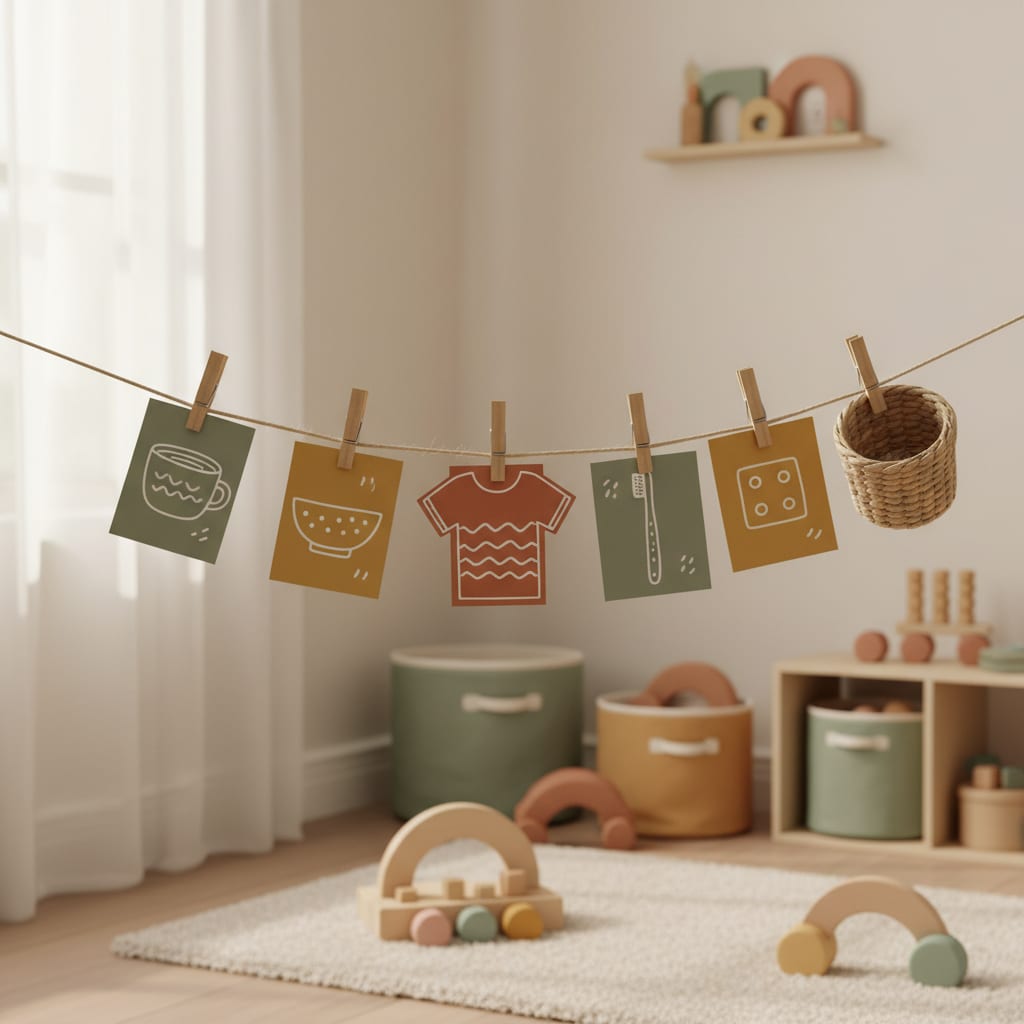
Here’s the preschool move that changed our mornings most: routine cards. A little picture card for each step — cup, bowl, shirt, toothbrush, toys — clipped in order at toddler height. Every morning she moves each card to the “done” side as we go, and somewhere around week two, the routine stopped being enforced and started being performed. She checks the cards. She tells ME what’s next, usually smugly. Handing a toddler visible ownership of the sequence converts the last resister into the routine’s biggest cop.
Making a set takes ten minutes — the full how-to (and the card list for the whole day, not just mornings) is in the toddler routine cards post.
Adjusting the chain by age
Around eighteen months, the chain is mostly yours to run — the toddler just rides it, absorbing the order. By two and a half, they can execute steps solo (“go get your shoes”) if the order never changes. By three, expect the negotiation phase to move inside the steps — which book at teeth-brushing, which shirt — and that’s fine; choices inside steps are free. What’s never up for debate is the sequence itself. And once the chain ends at a play handoff they can run alone, you’ve built the thing every SAHM morning needs: a morning block that starts without you pushing it.
FAQ: toddler morning routines
What time should a toddler morning routine start?
Whenever your toddler wakes — that’s the point of an event chain. The routine is an order, not a timetable: wake, milk, breakfast, dressed, teeth, play, whether the day starts at 5:50 or 7:15. Anchoring to events is what makes it battle-proof.
How long does it take for a toddler routine to stick?
Roughly two to three weeks of unbroken repetition for the order to become “just how mornings go,” faster with picture cards, slower every time the sequence gets shuffled. Consistency matters more than any individual technique.
Should I use a visual routine chart for my toddler?
Yes — it’s the single highest-leverage addition. Picture cards at toddler height turn the routine from something imposed on them into something they run. Most kids start policing the sequence themselves within a couple of weeks of getting the cards.
What do I do when my toddler refuses a step?
Stay boring: acknowledge, restate the chain, wait. “I know. After breakfast comes getting dressed. I’ll help when you’re ready.” No step gets skipped, no step becomes a fight you escalate. The routine outlasting their protest — calmly, a few hundred times — is the whole method.