Taste-Safe Sensory Play for the Mouthing Age
Taste-safe sensory play means building the bin from food-based materials — cooked pasta, dry oats, yogurt “paint,” mashed banana — so that when your mouther inevitably mouths, what goes in is food, not floam. It’s the version of sensory play for the stage when everything gets taste-tested: roughly the first two years, longer for some kids. Taste-safe does not mean unsupervised — you’re still within arm’s reach the whole time, because food can still be a choking risk. Here’s how we run it as a rotation slot, not a Pinterest project.
Taste-safe is a supervision downgrade, not a supervision waiver
Let me draw the line clearly, because “taste-safe” gets used loosely online. A taste-safe filler means an accidental mouthful isn’t a poison-control call. It does not mean the activity runs itself. Dry oats can still be inhaled in a fistful; a cooked pasta piece can still be crammed in whole. So the standing rules at our house, straight from my preschool-classroom days:
- You’re in the room, in arm’s reach, the entire time. Taste-safe play is a sit-with activity, not a make-dinner-while-it-happens activity. (The make-dinner activities come later — see easy toddler activities for what fills that slot instead.)
- Sized for the kid. For the under-two crowd, keep pieces either genuinely large or genuinely mushy. Skip whole grapes, hard chunks, popcorn, and anything else on the standard choking-hazard lists.
- Allergies decide the menu. Only use foods your child has already eaten without a reaction, and if you’re mid-introduction on allergens or have any family history, run your filler list past your pediatrician first. Every kid’s list is different; mine is not yours.
- Taste-safe isn’t snack time. A lick is fine and expected. If the bin is being eaten rather than played with, they’re hungry — feed them a real snack and try the bin later. Mixing up “this is play” and “this is food” makes both jobs harder.
The fillers that earn a rotation slot
This is a spoke of our sensory bin rotation system — same shallow bins, same one-bin-out-at-a-time rule, just with the filler shelf swapped to the edible aisle. The ones that have survived both my kids:
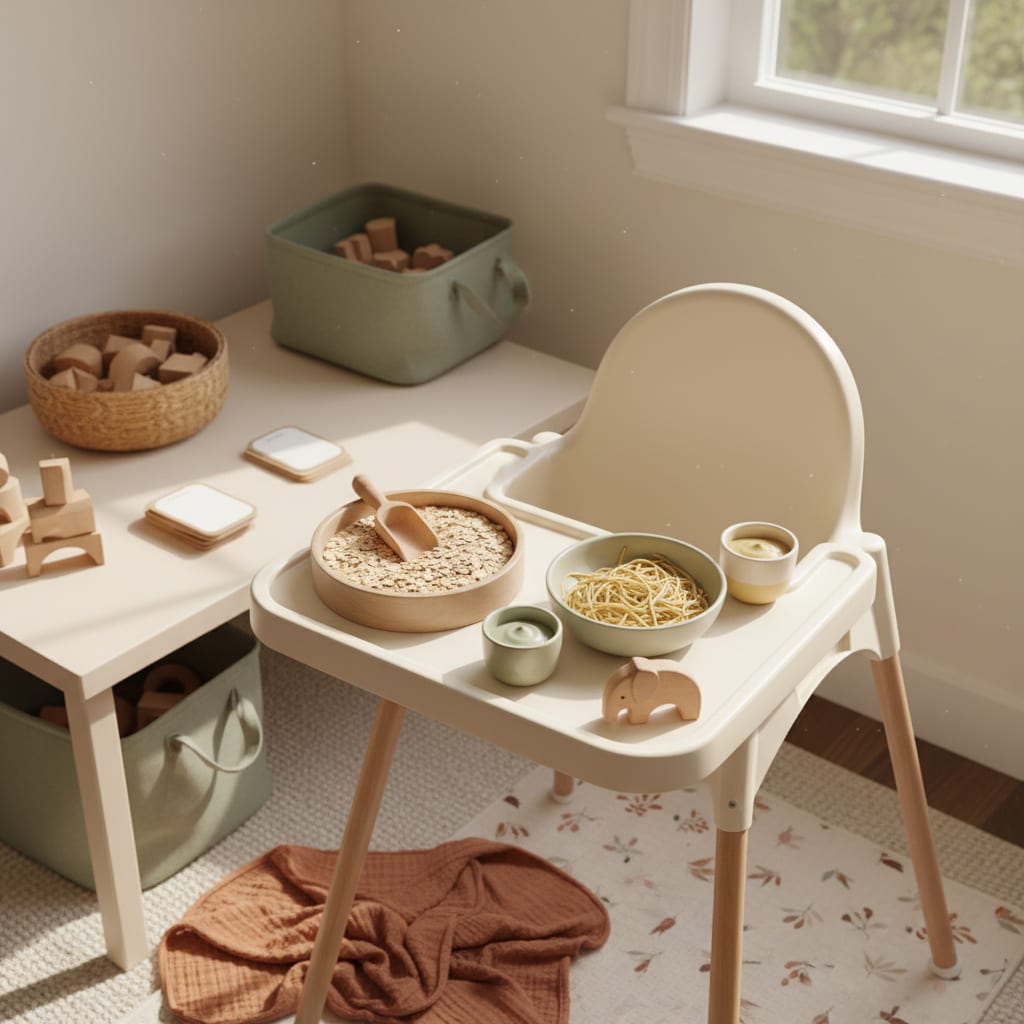
- Dry oats. The gateway filler. Scoopable, cheap, sweeps up dry. Add a measuring cup and a wooden bowl and you’ve bought yourself a stretch of the morning.
- Cooked spaghetti, cooled. Slippery, weird, wonderful. A drop of oil keeps it from clumping. This one is a high-chair-tray activity at our house — containment matters more than the bin.
- Yogurt paint. Plain yogurt in two or three cups, a smear of it on the high-chair tray or a bath wall. It’s finger painting where the inevitable taste is just breakfast.
- Mashed banana or cooked oatmeal “mud.” Full-mush textures for the youngest players. Maximum mess, zero choking-texture worry — which is exactly the trade you want at nine months.
- Cereal “dig site.” A bin of O-shaped cereal with a scoop and a couple of rounded animals to bury. Crunchy, familiar, and the taste-testing resolves itself fast because the novelty is in the digging.
- Water, always water. Technically the original taste-safe filler. A shallow tray, warm water, two cups. Arm’s-reach supervision is non-negotiable with any water, and a towel underneath is the whole setup.
Notice what’s not here: dyed rice (fine for the older sibling, ambiguous for the mouther), water beads (an absolute no at this age — they’re a serious swallowing hazard), and anything requiring a craft-store run. The 18-month-old morning runs happily on the pantry list above.
Where it sits in the day
Taste-safe bins are a big-block activity — mid-morning, after the post-breakfast reset, when you have the attention to sit with it and the energy to hose down the aftermath. Fifteen-second setup still applies: filler in bin, bin on splat mat (a cheap shower curtain outranks anything marketed for the purpose), two tools, done. Expect ten to twenty minutes of genuine engagement from a young toddler, and count the cleanup as part of the activity — scooping oats back into the bin is, to an eighteen-month-old, simply more game.
One honest note: this stage is short. The mouthing phase feels eternal while you’re in it, but most kids play their way out of it sometime in the second year, and then the whole craft-store world opens up. Taste-safe play is a bridge, not a curriculum. Build the cheap version, enjoy the weird spaghetti photos, and don’t buy a kit.
FAQ: taste-safe sensory play
What age is taste-safe sensory play for?
Roughly six months to two years — from sitting-up-and-grabbing until the mouthing phase fades. There’s no hard cutoff; some two-and-a-half-year-olds still taste-test, and the pantry fillers work fine for older kids too. Match the bin to the kid in front of you, not the age on a chart.
Is taste-safe the same as edible?
Functionally yes — every filler should be a food your child has already safely eaten. The distinction worth keeping is intent: it’s play that happens to be edible, not a meal. If the bin is being steadily eaten, pause and serve an actual snack instead.
Do I still need to supervise taste-safe play?
Yes, at arm’s reach, the entire time. Taste-safe removes the toxicity worry, not the choking one — food textures and fistfuls still need eyes on them, and any water play needs you right there regardless. Check with your pediatrician if you’re unsure which textures your child is ready for.
How do I keep the mess survivable?
Contain first: high-chair tray for the wet fillers, a splat mat under the bin for the dry ones, and one bin out at a time. Dry fillers sweep; wet fillers happen right before bath time on purpose. Scheduling the mess is nine-tenths of tolerating it.