Play at 3: Setups That Buy You Twenty Minutes
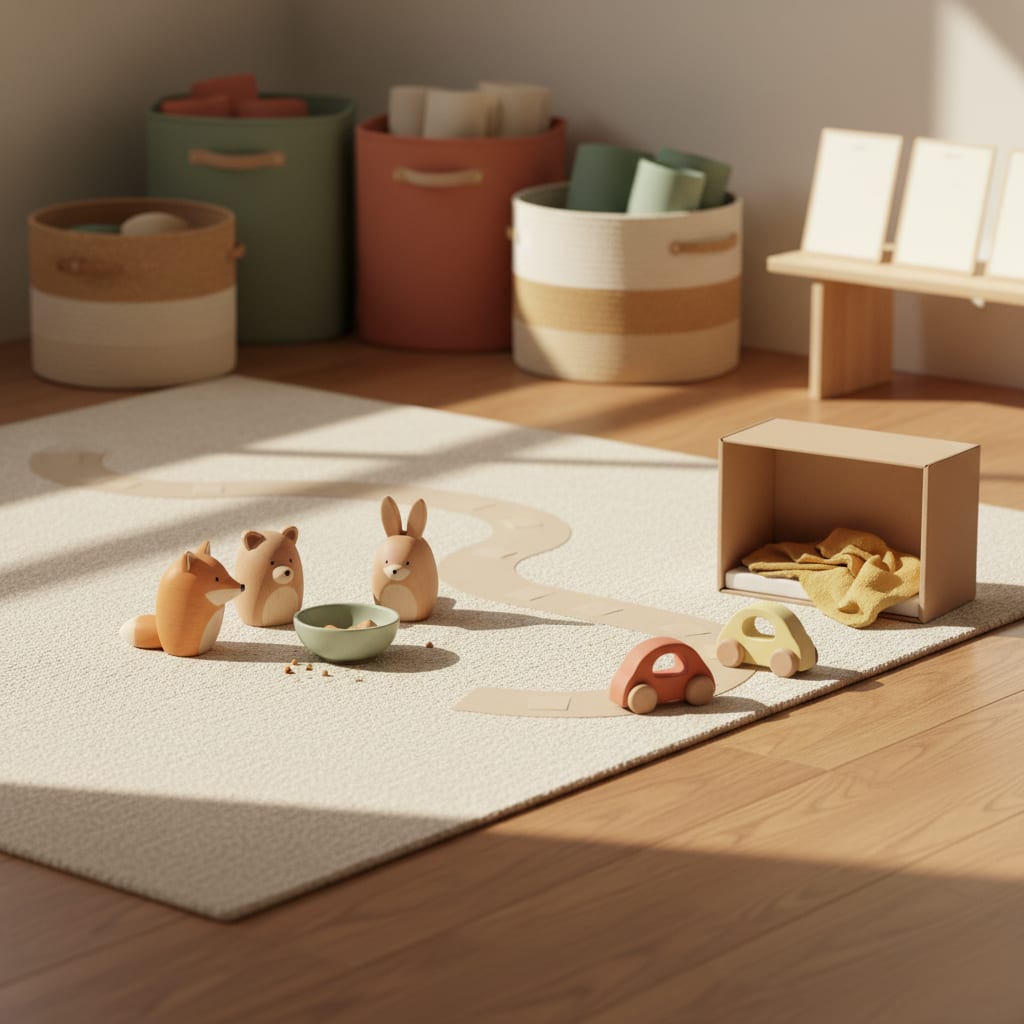
Play at 3 runs on pretend, which means the setups that buy you real time are scenes, not activities: three animals arranged mid-picnic, a doll tucked into a shoebox bed, cars lined up at a masking-tape gas station. Stage a tiny story-starter, walk away, and a 3-year-old’s narrative brain does the rest — often for twenty minutes or more. The setup takes fifteen seconds; the trick is that you’re not providing entertainment anymore, you’re providing a prompt. This post is my roster of scene-starters, plus the staging tricks that make them land.
What changed at 3 (and why your old tricks stopped working)
Somewhere around the third birthday, the transfer-and-dump play of toddlerhood gives way to story. Kids this age narrate constantly — the animals have names, the tower is a castle, the couch is a boat — and play that doesn’t feed the story engine starts dying fast. It’s why the bin that bought forty minutes at two suddenly buys six: pouring for its own sake is done. Pouring soup for the bears’ restaurant is a different economy entirely.
The practical shift: stop setting out materials and start setting out situations. Same toys, same fifteen seconds — different frame.
The invitation trick: stage it, then leave it
In preschool we called these invitations to play, and the whole method fits in two rules:
- Set the scene before they see it. Three animals around a bowl “discovered” after breakfast beats the same animals handed over with “want to play picnic?” A found scene is a mystery; an offered activity is a chore. Do the staging during quiet time or after bedtime — it takes under a minute.
- Start it, don’t run it. If they hesitate, give the scene one line of plot — “oh no, the cow’s still waiting for her breakfast” — and drift away. The fastest way to kill twenty minutes of pretend is to stay and direct it. Your exit is part of the setup; if stepping back is a battle in your house, that’s the independent play skill, and it’s trainable.
The scene-starter roster
- The animal picnic / vet clinic / bedtime. A few animals plus props from the kitchen: bowls for the picnic, a scarf for bandages, washcloths for blankets. The same six animals support months of different scenes.
- The small world in a dish. A baking dish with a handful of dried beans or shredded paper, two dinosaurs, some pebbles and a cup laid on its side as a cave. Small worlds are the 3-year-old evolution of the sensory bin — same tub, promoted from texture to habitat.
- The tape road. Masking-tape roads across the floor, cars parked at the start, a block “gas station.” Tape peels up in seconds; the road network survives all week if you let it.
- The shoebox house. A shoebox on its side, fabric-scrap bedding, one doll or animal in residence. Moving day — relocating the resident and furniture to a new box — is somehow a whole separate afternoon.
- The line of something mid-task. Weirdly reliable: toys arranged as if interrupted — cars queued at a wall, animals facing a closed cabinet, blocks half-stacked. Three-year-olds cannot leave an unfinished story alone.
- The real-tools job. A spray bottle of water and a cloth to “wash” the windowsills, a dustpan assignment, sorting the sock pile. At 3, real work is pretend play with better props, and it runs alongside your actual chores.
Making twenty minutes the norm, not the jackpot
Three staging habits separate the six-minute scenes from the twenty-plus ones. Fewer pieces, better story: three animals with a problem beat fifteen animals in a heap — abundance kills narrative. Rotate the cast: the same scene with swapped characters reads as brand new, which is the rotation logic that runs our whole activity roster. Respect the deep-play state: when the monologue starts and they stop checking where you are, do not interrupt for snacks, praise, or photos. Absorbed play extends itself if nobody trips it.
And place the scenes where the day needs them: the found-scene after breakfast launches the morning; a calm shoebox setup restocks quiet time for the kids who’ve traded the nap; the tape road bridges the pre-dinner stretch. A good scene is worth more in the right block.
What still flops at 3 (mostly)
Board games with real rules, crafts with more than two steps, anything requiring losing gracefully, and long collaborative builds where your vision matters. The narrative engine is running, but impulse control is still in the mail. Keep rules-based play for short together-time bursts and let solo play stay story-shaped — that’s where the twenty-minute stretches live.
FAQ: play at 3 years old
How long should a 3 year old play independently?
With a scene that lands, fifteen to thirty minutes of absorbed solo play is realistic for many 3-year-olds — but it varies a lot by temperament and practice. If you’re starting from two minutes, build the skill gradually; the setups here are the easy mode for practicing.
What are the best activities for a 3 year old at home?
Pretend-play scenes: small worlds, animal scenarios, tape roads, shoebox houses, and real-work jobs with real tools. At this age, story-shaped setups outperform materials-shaped ones — the same toys staged as a situation buy dramatically more time.
Why does my 3 year old want me to play with them constantly?
Usually because play has always come with you attached, so your presence feels like part of the activity. Staged found-scenes plus a graceful exit retrain that gently — you start the story, they own it. Keep some genuine together-play daily; the goal is a mix, not a handoff.
Do 3 year olds still need sensory play?
Yes, but it evolves — texture-for-texture’s-sake gives way to small worlds where the beans are the dinosaur swamp. Keep the tubs, add characters and a scenario, and the sensory setup graduates with the kid instead of retiring.