When Your Toddler Wakes the Second You Sit Down to Eat
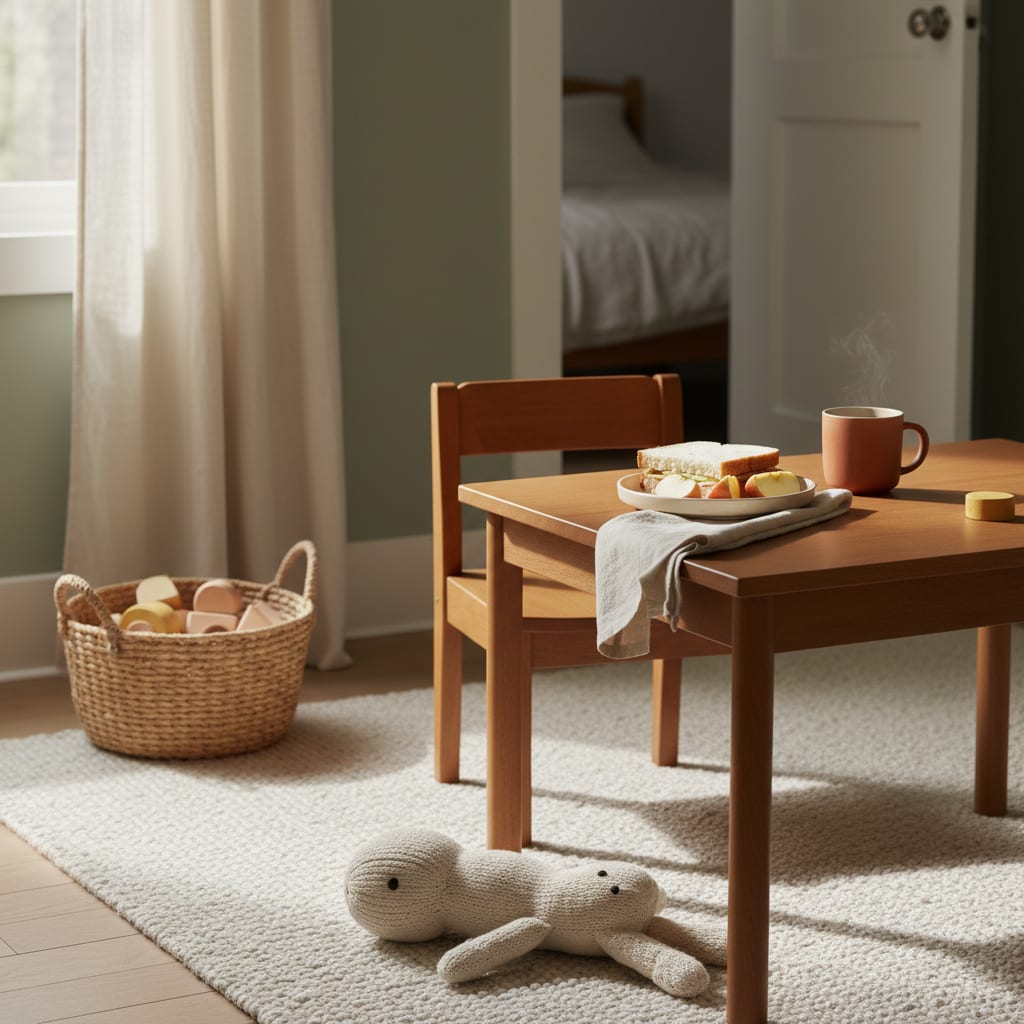
It is not bad luck and it is not a sixth sense. Your toddler wakes the moment you sit down because of the way the two of you are sequenced: you spend the first twenty or thirty minutes of the nap doing the loud, useful things — dishes, tidying, the kettle — and only sit down once the house is quiet, which lands you at the table at roughly the same moment the first sleep cycle ends. The noise stops and the seam arrives together. Fix the order and you get your lunch back.
Why the timing is not a coincidence
Two ordinary things line up.
The cycle seam. Small children move through sleep in loops of roughly thirty to forty-five minutes, and everyone surfaces briefly at the end of one. A kid who links cycles rolls over and continues; a kid who doesn’t wakes fully. That’s the mechanism behind the eerily punctual thirty-minute nap, and it means there is a predictable vulnerable moment about half an hour after they went down.
Your own thirty minutes. Ask what you actually do with the first half hour of naptime. Almost every mom I know does the same thing: the noisy jobs first, because they can’t happen with a toddler underfoot. Loading the dishwasher, wiping counters, running the disposal, moving laundry, putting away the blocks. Then, job done, you make a plate and sit down — and the house goes silent for the first time all morning.
So the sound floor drops off a cliff at minute twenty-five, and the sleep cycle ends at minute thirty. It isn’t that your toddler senses your sandwich. It’s that they surface into a house that just changed, at the one moment they’re most likely to surface at all. A step in noise wakes children; steady noise, even loud noise, mostly doesn’t.
Move your lunch, not the nap
The rhythm fix is the boring one and it works: stop scheduling your meal inside the nap.
Eat lunch with your toddler, before the ramp starts. Not a supervised standing-at-the-counter arrangement — actually sit, actually eat the same meal, at the table, at 11:45. It sounds like a downgrade. It isn’t, for three reasons. Your food no longer depends on a nap that may run thirty-five minutes. Your toddler eats better with a modelled meal in front of them, which helps the nap. And the nap block stops carrying two incompatible jobs — the naptime work block and your only meal — that were always going to collide.
Then reassign the first thirty minutes of the nap. That stretch is now for the quiet jobs, not the loud ones: sitting work, folding, a book, the thing you actually want the block for. The loud jobs move to the second half, once the seam is past, or into the after-nap block where the noise doesn’t cost you anything.
That single swap — meal before, quiet first, noise later — solves most of these days by itself.
Keep the sound floor flat
The second half of the fix is to stop the house from changing so dramatically in the first place.
- Sound cover stays on for the whole nap, not until you think they’re settled. A machine that runs at a steady volume, in the room, all nap, is the single most reliable protection against the surfacing-into-silence problem.
- Don’t tiptoe. A silent house has nowhere to go but louder. A house running a normal, boring hum — the dishwasher, a fan, a podcast at low volume in the kitchen — absorbs the truck outside and the neighbour’s door without producing a step change.
- Batch the genuinely loud things. The blender, the vacuum, the coffee grinder: do them all in the same five minutes, early, or not during the nap. Ten separate loud moments spread over an hour is ten chances to catch a seam.
- Close the loop on the hard-floor stuff. Chair legs, the pantry door that bangs, the dog’s tags. One afternoon of felt pads and a rubber band on the tags buys back weeks of naps.
The five-minute rule at the door
When they do stir at the seam, what you do in the next few minutes decides whether it was a surfacing or the end of the nap.
Wait. Not forever — five minutes, by the clock, before you go in. The noise a child makes coming up out of a cycle sounds a lot like waking and often isn’t: grumbles, a shout, some thrashing, then silence again. If you go in at the first sound, you convert every surfacing into a wake-up and you teach the pattern you’re trying to break. If it escalates steadily rather than fading, that’s a real wake and you go.
The corollary, which is harder: if they’re genuinely up after thirty-five minutes, don’t spend forty minutes fighting it. Take the short nap, move quiet time earlier, and expect the late-afternoon stretch to be rough — planned-for rough beats surprised rough. A short-nap day is a day with a different plan, not a failed one.
When it’s the nap itself, not your lunch
Everything above is sequencing, and sequencing only helps if the nap has a shape to sequence around. If naps land anywhere from 11:30 to 2:00, if thirty-five minutes is the ceiling rather than the bad day, or if the whole thing has been sliding for weeks, the problem is upstream of what time you eat — and the usual culprit is a wake window that no longer fits the age they’ve grown into. That’s the same upstream question behind building the day around naps in the first place, and it’s worth a look at why the first cycle keeps ending the nap before you rearrange your own day again.
If you’d rather not reverse-engineer it from charts, the Betteroo sleep app is the one I point people at: you give it your child’s age and how they’re actually sleeping, and it hands back today’s nap window and bedtime, then keeps adjusting as they grow. It’s a tool, not a guarantee — toddlers still have opinions — but it removes the daily guessing about where the window should be.

A plate that survives a short nap
Last piece, and it’s practical rather than structural. Build your midday food so that it doesn’t matter when the nap ends.
Make it cold or make it reheatable, and make it in the morning. A plate assembled at 11:40 and eaten at 11:45 with your toddler is the goal; the backup is something that’s equally fine at 1:20 after a rescue. What ruins the day is the hot, timing-dependent meal you started at 12:50 — that’s the one that gets abandoned on the counter, and the resentment it generates is out of all proportion to the sandwich.
And protect the meal the same way you protect the nap. The nap holds because you defend it; your lunch deserves a smaller version of the same treatment — a fixed time, a low bar, and no dependence on anyone else’s sleep going well.
FAQ: naps that end the moment you sit down
Why does my toddler always wake up when I sit down to eat?
Because you usually sit down about half an hour in, right when the first sleep cycle ends, and because sitting down is when the house goes quiet. The drop in background noise and the natural surfacing point arrive together. It’s timing, not intuition.
Should I stay silent during naptime?
No — steady, boring noise is better than silence. Children wake at changes in sound, so a house with a constant low hum and sound cover in the bedroom protects the nap far better than tiptoeing, which only makes every unavoidable noise louder by contrast.
How long should I wait before going in when they stir?
Give it about five minutes unless the crying escalates steadily. Coming up out of a sleep cycle is noisy and often resolves on its own. Going in at the first grumble turns a surfacing into a wake-up and makes the pattern more reliable, not less.
When should I eat lunch as a stay-at-home mom?
Before the nap, with your toddler, at whatever time your ramp starts — usually somewhere around 11:45. It gets you a meal that doesn’t depend on the nap, it models eating for a kid who eats better with company, and it frees the whole nap block for one job instead of two.