The Errand-Day System: Groceries With Toddlers, Solved
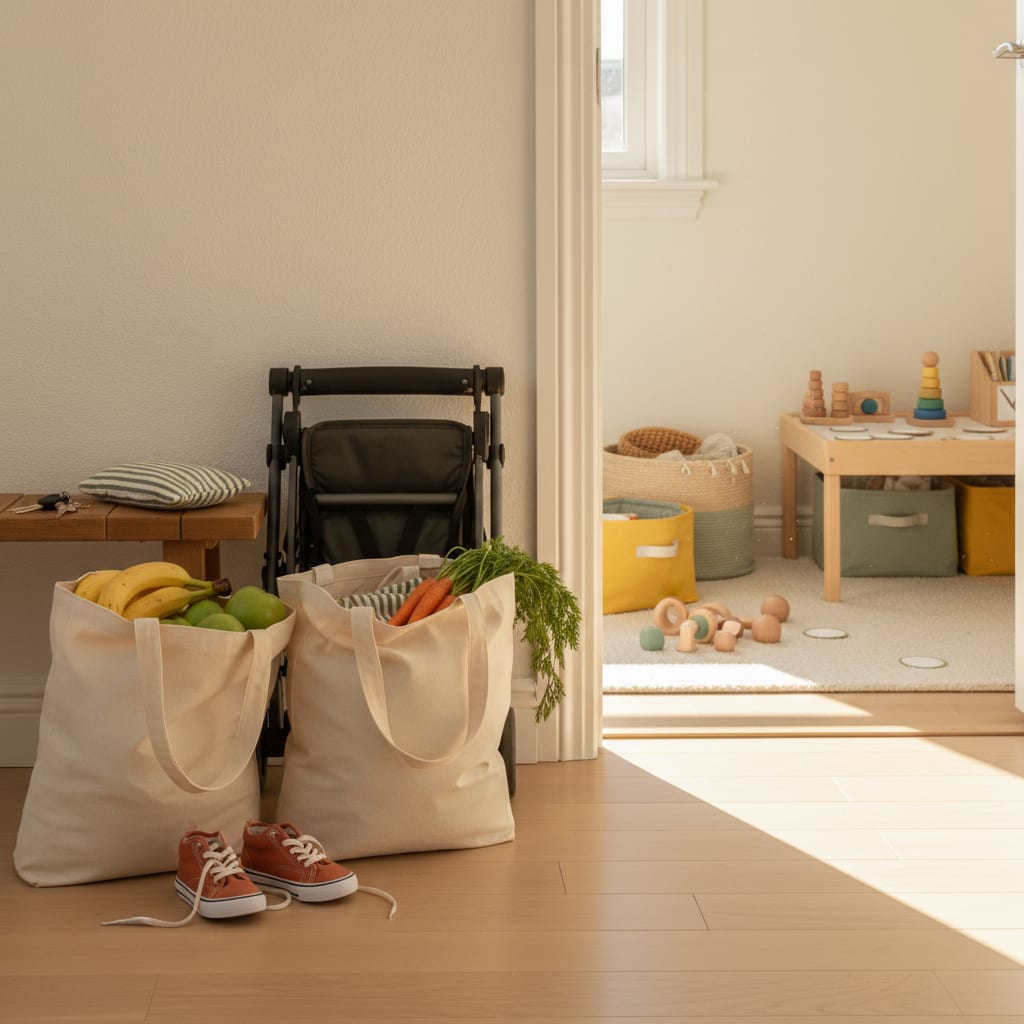
Errands with small kids work when you stop spreading them across the week and run them as one system: pick a single errand day, do it in the post-breakfast window before the nap, cap it at two stops, and give each kid a defined job in the store. Three short trips scattered across three mornings cost far more than one ninety-minute run, because the expensive part isn’t the shopping — it’s the transitions. Getting in and out of car seats, in and out of the store, and back before the nap window is the actual work, and you only want to pay for it once.
One errand day beats five quick stops
Every trip out has a fixed cost unrelated to what you’re buying: shoes, the bag, the car seats, the parking lot, the cart negotiation, the exit, the reload, and the decompression after. Call it forty-five minutes of overhead per outing. Five times a week is nearly four hours of pure transition.
Consolidate instead. One day where errands are the outing, and four days where the outing is a park, a walk, or the library. Everyone does better, and errand day itself gets easier because your kid learns its shape. Toddlers are fantastic at repeated sequences and terrible at surprises.
The single exception worth allowing: a standing tiny stop attached to an existing trip — the pharmacy next to storytime, the bank on the way home from the park. Attached stops don’t carry the overhead. New trips do.
The window: post-breakfast, pre-nap
The best hour for an errand with small kids is the mid-morning slot right after breakfast and the morning reset — fed, changed, freshly awake, still in the good half of the wake window. That’s usually somewhere between 9:00 and 10:30 in a typical home rhythm.
Two hard boundaries around it:
Home before the nap window closes. Not “back in time for the nap” — back with margin, because the last twenty minutes of an errand always take forty. If your nap-anchored day has a 12:30 nap, the errand ends at 11:30, not 12:20.
Never after 3pm. The late-afternoon store trip is where the truly memorable meltdowns live. If something is genuinely urgent, it’s a one-parent-goes-alone-after-bedtime job or a delivery, not a family expedition.
And mind the car-nap tax. A ten-minute doze on the way home can dissolve a whole afternoon nap — the mechanics of that are in the nap protection post, but the errand-day version is simple: keep the drive home short, keep it noisy, and if they’re going under, that’s the day you carry the groceries in fast and go straight to the crib.
Cap it at two stops
Two stops is the ceiling for one outing with a toddler. Three is technically possible and consistently a mistake. If your list has four stops on it, that’s two errand days, and the second one can wait until next week — which is almost always true, and almost always feels untrue at the time.
Order matters. Put the stop the kids like least first, while goodwill is highest, and end with the one that has some payoff — the library, the store with the free cookie, the drive-through car wash. Ending on a good note is what makes the next errand day easier, and errand day is a repeat game.
In the store: give them a job
The central insight is that a toddler in a cart isn’t bored, they’re passive, and passive is where whining grows. Give them a role and most of the trouble goes away:
- The holder. They hold one item for the whole trip. A box of pasta. That’s it. It works absurdly well.
- The finder. “Find something yellow.” “Which apples should we get?” Real choices between two acceptable options, all the way around the store.
- The list-keeper. For a three-year-old: a few picture items you drew before you left, one crossed off each time. This is why the picture-card habit transfers so well — the same skill that runs a morning sequence runs a shopping trip.
- The counter. Six bananas, four cans, three peppers. Fills the same gap and doubles as math nobody has to feel virtuous about.
Two ground rules I hold: the snack comes from home, in a bag, before we go in — not bought and opened in the store, which teaches an expensive lesson. And the answer to “can we get” is decided before we walk in and stated out loud in the parking lot. My version: we’re getting the list, and nothing else today. Said once at the car, it holds. Said for the first time in aisle six, it doesn’t.
Pickup, delivery, or in-store: choosing per trip
There’s no universal answer, but the trade is fairly clean.
Curbside pickup wins when the trip is big, the kids are in a rough patch, or you’re solo with two. Nobody leaves the car, the impulse buys go to nearly zero, and a slot booked the night before removes the decision. On one income the impulse-purchase reduction alone often covers a pickup fee, which is worth doing the math on rather than assuming.
In-store wins when you need produce and meat you’d want to choose yourself, when substitutions would wreck the plan, or when the outing is genuinely serving as the day’s outing. An unhurried store trip is real stimulation for a two-year-old — a huge, brightly lit place full of naming practice.
Delivery wins for the boring heavy stuff — paper goods, canned goods, diapers on a subscription — where you’re paying to not carry things while holding a toddler.
Most weeks I do one in-store run and one pickup, and I don’t feel any way about it.
The reload, and the ten minutes after
The trip isn’t over at the car. The unload is when things fall apart, because you’re holding twelve bags and the kids have been contained for ninety minutes and are done being contained.
What works: cold items in one bag, brought in first, everything else can sit for ten minutes. Kids out and loose in the house or the yard first, groceries second. And then — this is the part I got wrong for a year — build in ten minutes of nothing before you attempt lunch. Errand day runs long on transitions, and a straight jump from parking lot to lunch table is one transition too many for everyone, including you.
When it goes badly anyway
Some trips break. The floor-lying, the shrieking, the cart refusal. The honest options are: leave with what’s in the cart, leave without it, or finish fast with a narrow scope. All three are fine, and leaving is not a failure — a two-year-old melting down in a bright loud store is not a discipline moment, it’s a capacity moment.
What I’d avoid is the negotiated bribe at the checkout, because it teaches exactly the sequence you don’t want. If a rough trip happened, the fix is upstream: earlier window, shorter list, fewer stops, snack first. And if the whole day has gone sideways, the reset exists for that — the errand isn’t worth the afternoon.
FAQ: doing errands with toddlers
What’s the best time of day to run errands with a toddler?
Mid-morning, after breakfast and before the nap window — kids are fed, rested and in the strong half of their wake window, and stores are quieter than in the afternoon. Avoid anything after about 3pm, when both energy and patience are lowest.
How do I stop my toddler asking for things at the store?
Decide and state the rule in the parking lot before you go in, keep it identical every trip, and bring a snack from home so hunger isn’t driving the asking. Giving them a job in the cart — holder, finder, counter — removes most of the boredom the asking comes from.
Is grocery pickup worth it for stay-at-home moms?
Often, yes — particularly on solo weeks or big shops, where the reduction in impulse buys can offset the fee. Compare a typical pickup fee against what a full in-store trip with kids usually adds to your total, and decide per trip rather than as a policy.
How many errands can I realistically do in one outing?
Two stops. Three is where most toddler outings turn, and the third stop is almost always something that could wait a week. If the list runs long, split it across two errand days rather than stretching one.