A SAHM Rhythm for Weeks Your Partner Is Away
When your partner travels, don’t run your normal week with one less adult in it — run a deliberately smaller week. Cut the calendar to one outing a day, move the whole rhythm about thirty minutes earlier, pre-decide five dinners, and simplify bedtime to the shortest version that still works. What breaks in a solo week isn’t the tasks; it’s the handoffs — the ten minutes of coverage you use to shower, take a call, or start dinner without a toddler attached. Plan for missing handoffs rather than for missing help, and the week gets survivable instead of heroic.
What actually breaks when you’re alone
Most of what makes an ordinary home day work is invisible relief. Somebody holds the baby while you shower. Somebody takes bedtime on the night you’re done. Somebody is in the house, so the monitor isn’t your entire nervous system from 7pm on.
Solo, all of that goes at once, and the losses are worth naming, because each has a different workaround:
- No coverage gaps. No hands-free ten minutes at any point between wake-up and nap.
- No split bedtime. With two kids this is the big one — the whole ramp becomes serial rather than parallel.
- No off switch at 7pm. The evening stops being recovery and becomes second shift plus listening duty.
- No one to talk to. Twelve hours of toddler conversation with no adult sentence at the end of it, which is the part most people underestimate.
Notice that four of those are not about workload. Solo weeks feel hard out of proportion to the extra tasks because the losses are structural.
Rule one: shrink the week before it starts
Do this on the weekend before, not on Monday night when you’re already behind.
Cancel one thing. Whatever’s most negotiable — the class, the playdate, the appointment that could be next month. One deleted commitment is worth more than any coping strategy.
Pick the week’s floor, not its goal. Mine is: everyone eats, everyone sleeps, the kitchen gets reset once a day, and we leave the house once a day. Anything above that is a bonus, and the cleaning rhythm that runs in normal weeks goes down to dishes and one load of laundry a day. Deep-cleaning a house you’re solo-parenting in is a trap.
Do the Sunday prep with a bias toward dinners. Five decided dinners is the single highest-value hour of prep for a solo stretch, because dinner lands in the exact hour you’re most depleted. A Sunday reset that normally covers the whole house should, this week, mostly cover food.
Set the ask. If you have people, ask before you’re desperate — a specific window (“could you take them Wednesday 4 to 6?”) gets a yes far more often than “let me know if you can help.” On one income the paid version isn’t always available, but two hours of a neighborhood teenager on the hardest afternoon is often the cheapest sanity in the budget.
The solo-week day shape
Keep your normal daily rhythm, with four adjustments:
Everything moves earlier. Wake, meals, outing, nap, bath, bed — thirty minutes ahead of normal. You’re the only adult, and every step will run long, so start with a buffer instead of hoping for one.
One outing, in the morning. Out of the house before the nap window, back before it closes. Two outings a day is how solo weeks go wrong: the second one costs the nap, and the nap is the only break you get.
Naptime is not chore time. In a normal week I might do a load of laundry or answer emails during the nap. Solo, that hour is mine — sit down, eat something, have a drink that’s still hot. This is not indulgence, it’s the only handoff you have all day, and skipping it is exactly why day four is worse than day two.
Front-load the afternoon. Get the physical outlet and the messy setup done before four, so the hardest hour is downhill. Solo, the pre-dinner block is the one that decides how the night goes.
Bedtime is the whole game
With one kid, solo bedtime is a slightly lonelier version of normal. With two, it’s a logistics problem, and it’s worth actually deciding your approach rather than improvising it at 6:45.
The two workable patterns:
Stagger it. Little one down first while the big one has a screen or a contained setup on the floor of the same room. Then the big one, unhurried. Longer overall, calmer, and it’s what I use when I have anything left.
Merge it. Everyone in one room, one bath, one story, lights out together. Faster and louder, and it works better than people expect if you keep the sequence identical every night. The little one usually falls asleep to the noise.
Whichever you pick, cut the ramp down. Solo week is the week to drop the second story, the elaborate song, the water refill negotiation. A predictable short ramp holds up far better under one adult than a lovely long one that collapses halfway through.
And put your own bedtime in the plan. The single most common solo-week mistake is reclaiming the evening as “my time” until midnight and then paying for it every day after. One good evening, then early nights — you’re the only adult on duty, and tired-you is the resource the whole week runs on.
Meals, minimum-viable version
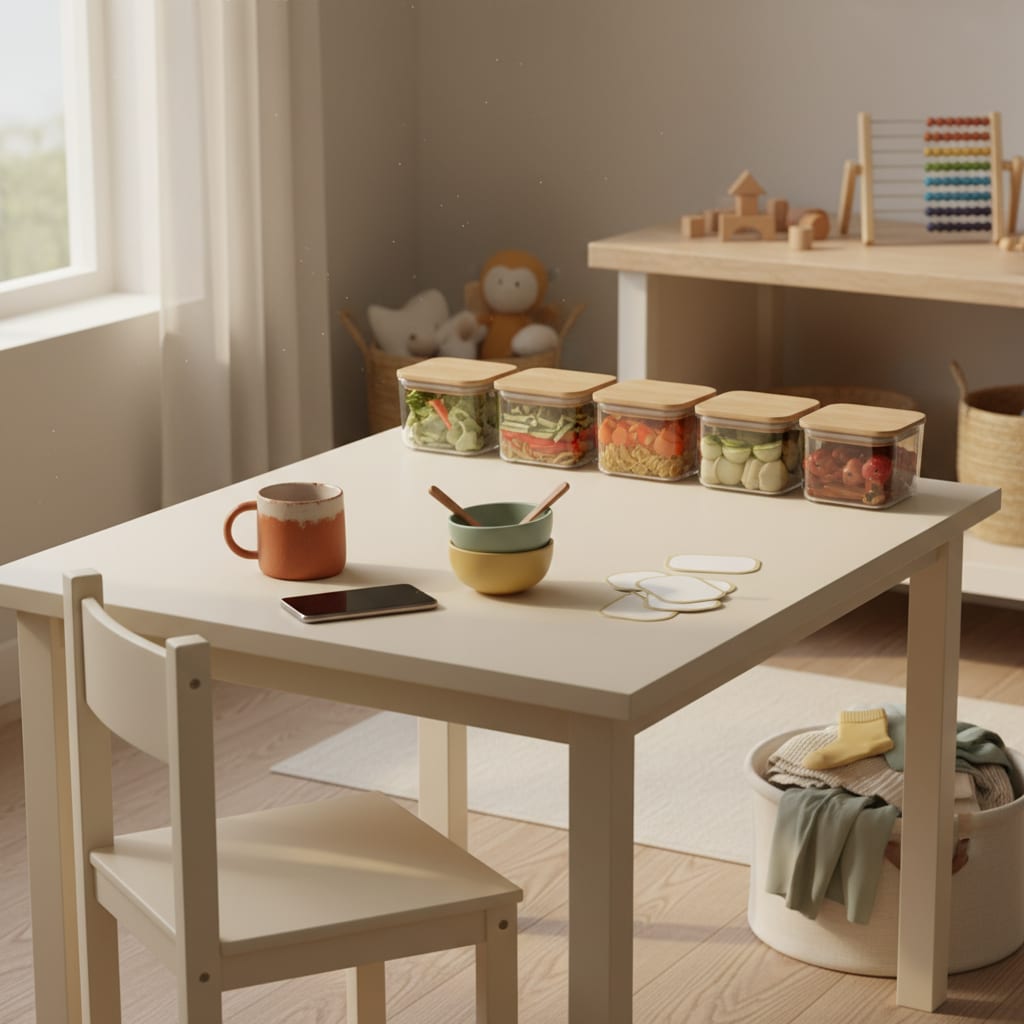
Five decided dinners: three repeats, one breakfast-for-dinner, one takeout or a freezer meal you kept for this. Lunch is the same thing every day and nobody minds. Groceries happen once, before the week starts — a solo mid-week store run with two kids costs more than the food. If your grocery system already runs on a repeating list, this is that list with the ambitious items removed.
The loneliness part, said plainly
Day one is fine. Day two is fine. Days three and four are where the flatness shows up, and it is not because you’re failing — it’s twelve-hour days of unbroken caregiving with no adult exchange at the end of them.
So schedule the adult contact like it’s an appointment. A standing evening phone or video call, a neighbor on the sidewalk at five, one text thread that’s active during the 4pm hour. If you have a park friend, this is the week to use them — the mom-friend infrastructure you built for ordinary weeks earns its keep here.
The re-entry day
Two things I’ve learned about the day they come home. First, expect the kids to fall apart rather than celebrate; they held it together for a week and the safe person walking in is when it comes out. Second, hand over immediately and go somewhere alone for an hour, that day if possible. Waiting for a good moment to ask means it doesn’t happen, and then the solo week never really ends — it just fades into a resentful weekend. Say it in advance: when you land, I’m going out for an hour. It’s a fair trade and it makes the next trip much easier to face.
FAQ: solo parenting weeks when your partner travels
How do I survive a week alone with toddlers?
Shrink the week rather than toughing it out: one outing a day, a decided dinner list, a lowered cleaning bar, and an earlier daily rhythm to absorb the delays. Protect naptime as your own break instead of using it for chores, and put one adult conversation in every single day.
Should I change our routine while my partner is away?
Keep the shape and simplify the steps. Kids do better with the familiar order of the day, so the same sequence with a shorter bedtime ramp and fewer outings beats an entirely new schedule that nobody can hold.
How do I do bedtime alone with two kids?
Pick stagger or merge in advance and run it identically every night. Stagger — youngest down first while the older one has a contained activity — is calmer; merging everyone into one room is faster. Improvising nightly is what makes it feel impossible.
Why do my kids act out when my partner comes back?
Because the effort of holding it together for a week is released the moment the other safe adult reappears. Expect a rough re-entry day, plan a low-key evening, and hand off for an hour of time alone rather than waiting to be offered it.