Wake Windows by Age: The Cheat Sheet Moms Actually Use
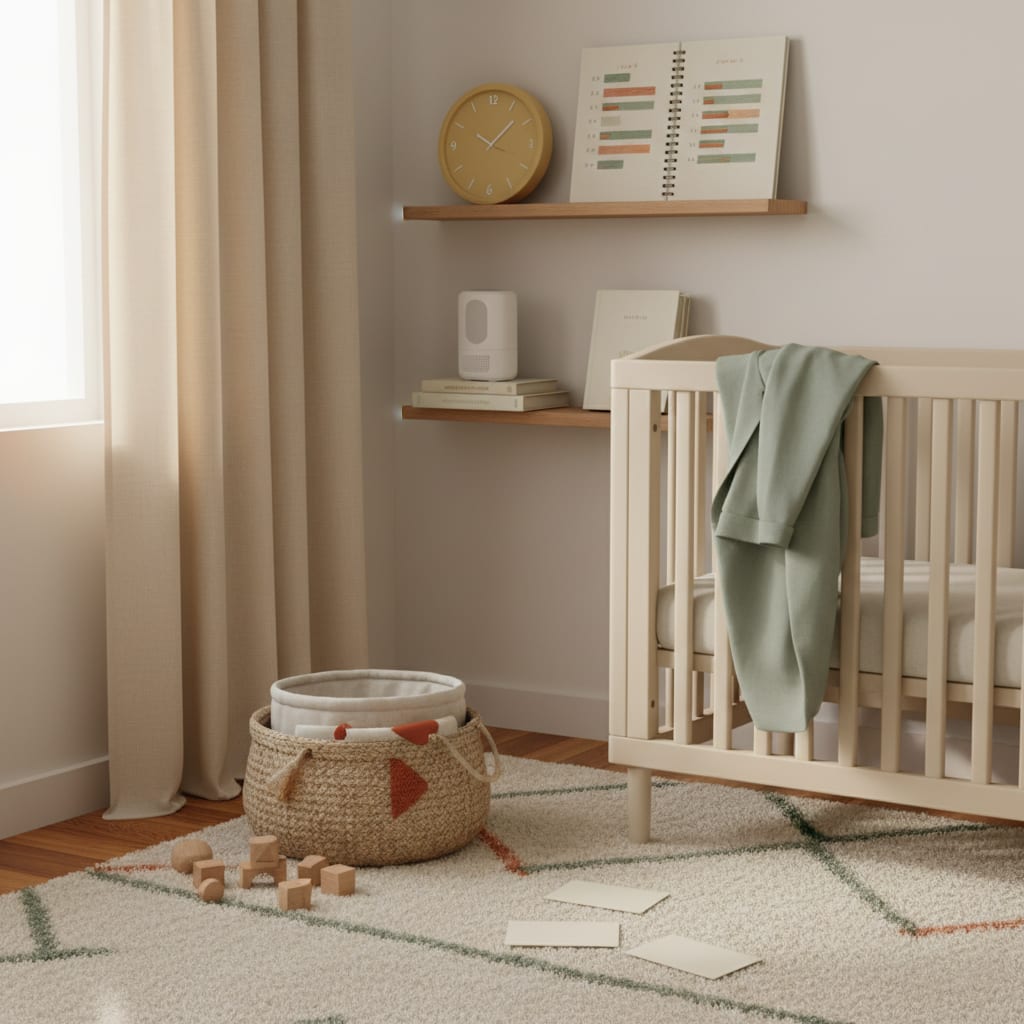
Wake windows by age, the short version: newborns manage roughly 45 to 90 minutes awake at a stretch, six-month-olds around 2 to 3 hours, one-year-olds around 3 to 4, and by the one-nap toddler years the windows stretch to roughly 5 to 6 hours on either side of the afternoon nap. Those ranges are the general consensus you’ll find across mainstream wake-windows-by-age references — and every actual kid drifts from them. The chart below is the starting grid; the more useful skill is reading your own kid’s drift, because the windows are the inputs your whole home day gets built from.
The cheat sheet
Ranges, not prescriptions — rounded to what the mainstream sleep world broadly agrees on, and hedged on purpose:
| Age | Typical wake window | Typical naps |
|---|---|---|
| 0–3 months | roughly 45–90 min | 4–5+, scattered |
| 4–6 months | roughly 1.5–2.5 hrs | 3–4 |
| 7–9 months | roughly 2–3.5 hrs | 2–3, settling to 2 |
| 10–12 months | roughly 3–4 hrs | 2 |
| 12–18 months | roughly 3–5 hrs | 2 → 1 (the big transition) |
| 18 mo–3 yrs | roughly 5–6 hrs | 1, slowly shrinking |
Windows usually run shortest first thing in the morning and longest before bedtime, and the ranges widen as kids get older — which is the chart’s quiet confession: the older your kid, the less a chart can tell you and the more their actual behavior has to. If sleep is going fine at numbers outside these ranges, your kid is not broken; the chart is generic. And for the sleep itself, the safety basics don’t change with any schedule — back sleeping, bare crib, and your pediatrician for anything beyond general information like this.
Windows are inputs, not the schedule
Here’s the reframe that makes the chart actually useful for a stay-at-home parent: wake windows aren’t a schedule to enforce — they’re the inputs you feed into the day’s architecture. In a nap-anchored day, the naps are the fixed anchors and the blocks between them are where life happens. The wake window is simply how long each block gets to be.
That’s why the chart matters beyond the crib. A roughly three-hour window with a ten-month-old means the morning block holds a walk or an errand or the sensory bin — not all three. A toddler’s five-plus-hour window means the morning can carry a real outing and still land the nap on time. Read the window, size the block, fill the block. Our day with an 18-month-old is this exact exercise written out hour by hour — two windows, two naps, and the blocks drawn to fit.
The practical habit: anchor the windows to events, not the clock. “About two and a half hours after she wakes up” survives a rough night, a late morning, and a car nap; “10:00 sharp” survives nothing. Rhythms, not schedules — the window is elastic by design.
When to ignore the chart: reading the drift
Every kid drifts from the chart — that’s not the chart failing, it’s your kid growing. The skill is spotting which direction:
Window too short (undertired): the nap takes twenty-plus minutes of fighting to start, or starts fine and pops at thirty minutes, or bedtime becomes a party. Fix: stretch the pre-nap window by ten or fifteen minutes and hold it a few days.
Window too long (overtired): meltdowns before the nap, wired-frantic energy at bedtime, short jagged naps, or new night waking and too-early mornings. Confusingly, overtired often looks like “not tired.” Fix: shrink the window the same ten-to-fifteen minutes, same few-days test.
The drift is permanent: if you keep needing to stretch, that’s not a rough patch — that’s the chart’s next row arriving. Windows lengthen steadily across the first years, and yesterday’s perfect timing quietly becomes today’s undertired nap fight. This is also how 30-minute naps sneak into a rhythm that used to work.
One variable at a time, a few days per test, notes on your phone. It’s a fine system; it’s also a slow one, and the target moves as they grow — which is why I eventually stopped hand-running the experiment. Betteroo is a baby-and-toddler sleep app that does the personalizing for you: it builds today’s nap windows and bedtime from your kid’s age and actual sleep history, then keeps adjusting as they grow — essentially the chart above, but tuned to your specific kid and never out of date. It runs around $20 a month, and it’s a tool, not magic: it hands you well-timed windows, and you still parent the kid through them. What it replaces is the guess-and-check — which, if you’re mid-drift with a chart that stopped working, is the part worth replacing.

FAQ: wake windows by age
What are wake windows, exactly?
The stretch of awake time between sleeps — from wake-up to the next nap’s start. Timed roughly right, enough sleep pressure builds for a good nap without tipping into overtired. They’re counted from wake to sleep, including feeding and the wind-down ramp.
How strict do wake windows need to be?
Not very — they’re ranges, and treating them as targets within fifteen or so minutes works better than clock-perfectionism. Anchor them to events (“about two hours after she woke”) rather than fixed times, and expect the right window to lengthen steadily as your child grows.
Why doesn’t the chart work for my kid?
Because it’s generic and your kid is specific — sleep needs genuinely vary, and every kid drifts from published ranges. Use the chart as a starting point, then adjust by evidence: fighting the nap means stretch the window, meltdowns and jagged naps mean shrink it. If sleep works at “wrong” numbers, keep your numbers.
When do wake windows stop mattering?
They fade as a daily tool once your child is down to one solid afternoon nap — by then the rhythm itself holds the timing. They matter again briefly during nap transitions, and the concept quietly retires when naps end altogether, somewhere in the three-to-five range for most kids.