Toddler Bedtime When an Older Sibling Games Late
If your ten-year-old is mid-match at eight o’clock and your two-year-old is meant to be asleep by seven-thirty, the answer is not a later toddler bedtime or a banned console. Stagger the evening instead: put the loud half of your older child’s night before the little one goes down, protect the first hour after bedtime as a quiet window, and let the rest run normally. One deliberate hour is the whole fix, and it costs nothing — which matters when there is no second living room to send anyone to.
The hour after bedtime is the only one you have to defend
A toddler woken by a shout at 8:05 is not simply “a light sleeper.” They are hitting the seam between their first and second sleep cycles at the exact moment the house gets loud, and that seam is the most wakeable point of the night.
Betteroo’s write-up of the wake that lands thirty to sixty minutes after lights-out calls it a false start, and makes the point worth holding onto: it is usually a timing problem rather than a noise one. If your toddler is overtired or undertired at seven-thirty, the headset gets blamed for a wake that was already coming.
But when the timing is right and the wake still lands at the same minute nightly, look at what the house does at that minute. It is nearly always the same thing: everyone who was tiptoeing through the bedtime routine relaxes, the volume comes back, and your older child’s voice arrives on top of a sleep cycle transition.
So you do not need a silent evening. You need a quiet window — bedtime to bedtime-plus-an-hour — and then you can have your house back.
One income usually means one living space
This is the part the general advice skips. “Move the setup to the basement” assumes a basement; “give him his own TV” assumes a second TV. A one-income house is often a smaller house, and the console lives in the living room because that is where the outlets and the family are.
So you cannot buy distance. You buy sequence instead — the same trick that makes a nap-anchored day work when one adult owes two children different things. Nothing moves rooms; things move in time.
Split the evening into three windows
Write them down once and everyone in the house can run them.
The loud window — dinner to bedtime. Voice chat, the competitive match, the video where somebody yells. Name it out loud, because a kid who knows he has a protected loud stretch fights the quiet one far less. If he picks his game at seven twenty-five, he will pick wrong.
The quiet window — bedtime to about an hour later. Headphones on, voice down, no slammed doors, no starting the dishwasher if it backs onto the bedroom wall. The rule is not silence but no new sounds — a flat sound floor, which a sleeping child tunes out far better than a silent house punctuated by one shout.
The free window — after the first hour. Deep sleep has settled in and ordinary household volume stops registering. Your older child gets his evening back, you get yours, and nobody has been asked to live in a library.
If the loud window keeps overrunning, the problem is upstream. A day that fell apart at four ends in a rushed bedtime routine, and the plan for the day’s hardest hour does more for eight o’clock than anything you can do at eight o’clock.
What actually travels through a wall
Two useful facts, pointing in different directions.
The game audio is the easy half — a wired headset removes essentially all of it, and this is one of the few parenting problems with a real hardware fix under the price of a takeout dinner. A plain wired set like the Logitech G335 plugs into a controller or a laptop, has a flip-up mic and needs no charging, which matters: a headset that is dead at 7:30 does not get used.
The hard half is your child’s own voice. Everyone gets louder wearing headphones, because they cannot hear themselves over the game. Most families with this complaint have already bought the headset and are baffled it did not work. The fix is a rule, not a purchase: during the quiet window, party chat is text or nothing — or one ear off, or something single-player for that hour. Pick one and keep it the same every night.
Then the door. A closed toddler door blocks a surprising amount and an open one blocks none of it, and the hall light going on at 8:15 is a wake-up signal even when nobody says a word.
When they share a room
The hardest version, and common in exactly the houses that have this problem. Stagger the bedtimes properly rather than hoping the older one will be quiet coming in.
- The toddler goes down first, on the normal routine, in the dark room.
- The older child spends that hour elsewhere in the house — a good slot for the homework or the shower nobody wants to do.
- He comes in at a fixed time, in the dark, with everything he needs already in the room. A pajama hunt at nine undoes the whole hour.
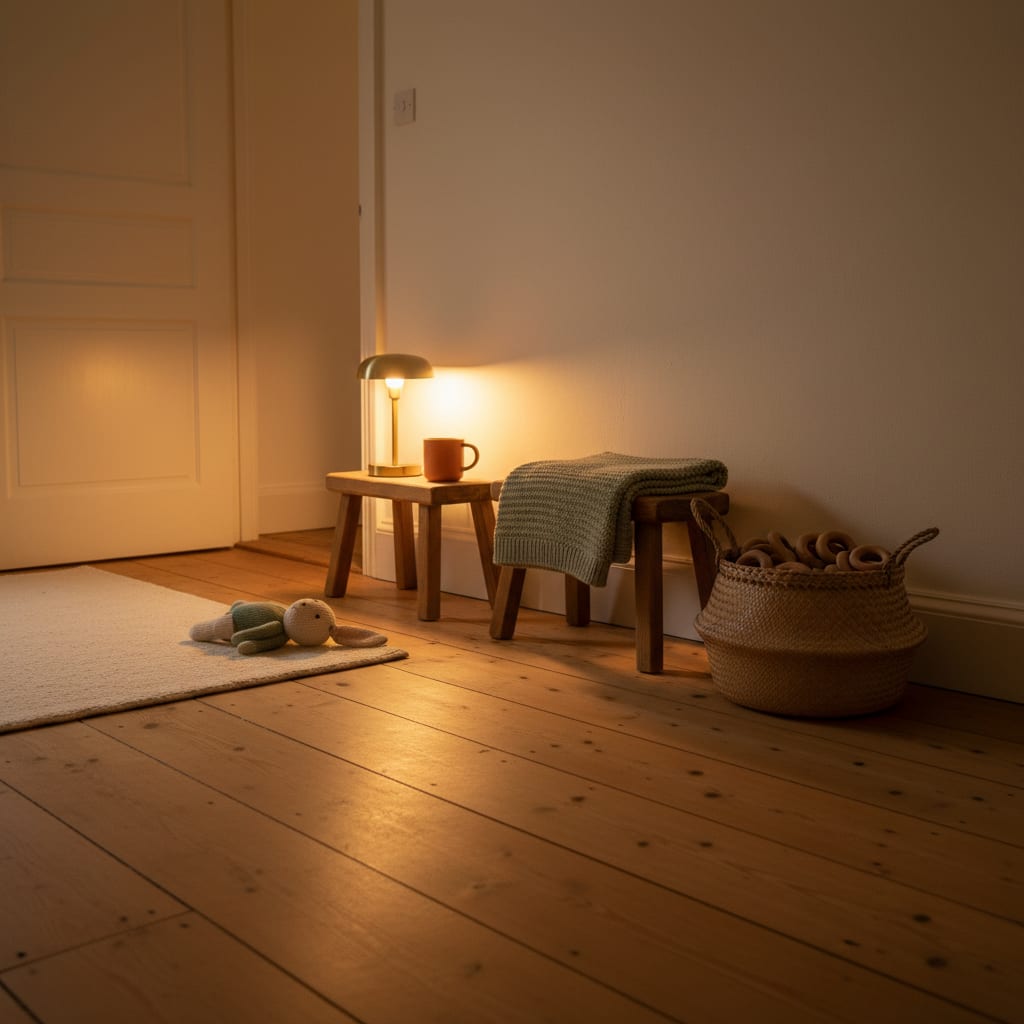
- Give him a small lamp on his side rather than the overhead. Overhead light in a shared room at nine is the most reliable way there is to wake a two-year-old.
Do not move bedtime to fit the evening
The tempting shortcut is pushing the toddler out to eight-thirty so everyone lands together. It backfires the way a late nap does: past their window you get a wired, harder-to-settle child rather than an hour of peace. Same mechanics that make a five o’clock nap wreck bedtime, at the other end of the day.
If you would rather not re-derive that time whenever the day goes sideways, let something else do the arithmetic — it takes today’s actual naps and hands back tonight’s window.

Have the conversation with your older child once
Not a lecture — a trade, stated plainly. He loses an hour of volume; he gains a later bedtime than his sibling, an uninterrupted evening afterwards, and a mother who is not sighing at him nightly at eight. Kids from about eight up handle a named constraint far better than a vague “keep it down,” which is unmeasurable and therefore unwinnable.
Say the true part too: we share the evening because we chose one income and one living room. Not a complaint, not an apology — the same arithmetic that runs the rest of the rhythm the week hangs on.
What to change first
In order, because changing all five at once tells you nothing about which worked:
- Move the noisy games earlier and name the quiet window.
- Close the toddler’s door and kill the hall light for that hour.
- Headset on, plus a rule about your older child’s own voice.
- Steady the sound floor before bedtime, not after the first wake.
- Only then look at bedtime itself.
Give each change four or five nights. A false start that survives all five is a timing problem wearing a noise costume.
FAQ: bedtime with an older gaming sibling
Should I make my older child stop gaming at my toddler’s bedtime?
No — a rule nobody can keep gets broken nightly. Ask for headphones and a quiet voice for the one hour after bedtime, then let the evening run normally.
Why does my toddler wake up thirty minutes after going to sleep?
That is the seam between the first and second sleep cycles, the most wakeable moment of the night. Noise landing there will wake them — but so will a wake window that was too long or too short before bed, so check the timing before rearranging the living room.
Do noise machines cover the sound of a game?
They cover steady sound well and sudden sound badly. A fan or Dohm sound machine running from the start of bedtime raises the floor, so a burst of voice is a smaller step above it. Switching one on after the wake does very little.
My kids share a room. Can this still work?
Yes, but stagger the bedtimes properly: the toddler settles first in a dark room, and the older child comes in later at a fixed time, with everything already there, using a small lamp rather than the overhead.