How to Sell on eBay: Kids' Clothes and Baby Gear
How to sell on eBay when the pile is outgrown kids' clothes and baby gear: the real fee math, lots that are worth listing, shipping with eBay, and getting paid.
In this post
To sell on eBay, you create a seller account, list each item (or a bundle) with photos, a title and a price, and ship it once it sells, often with a prepaid label eBay provides. Your money arrives in your checking account on a payout schedule you choose. For a mom with bins of outgrown clothes and baby gear, the key is the fees: most categories take 13.6% of the total the buyer pays, shipping included, plus 30 or 40 cents an order. That math favors size lots and better-quality pieces, not single cheap basics.
Is eBay the right place for your pile?
It depends on what’s in the bins. Each platform this site covers does a different job:
- Facebook Marketplace moves bulky gear locally with no shipping, which is why our guide to decluttering for cash starts there.
- Poshmark suits brand-name clothing with flat-rate shipping the buyer pays. Its fee math is in how to sell on Poshmark.
- eBay reaches the most buyers nationwide and handles almost anything you can box: clothing lots, shoes, small gear, toys, books, and specific brand-name items someone is searching for.
eBay’s strength is search. A buyer typing “boys 4T winter lot” or a particular brand and size will find yours even if they live three states away. Its weakness is that every sale has a fee floor, so a $4 item is rarely worth the effort.
The fee math
eBay’s selling fees page (loaded November 15, 2026) lists:
- Listing: “Every month, you get up to 250 zero insertion fee listings,” then $0.35 per listing.
- Final value fee, most categories: “13.6% on total amount of the sale up to $7,500 calculated per item.”
- Per-order fee: “For orders $10.00 or less the per order fee is $0.30, for orders over $10.00 the per order fee is $0.40.”
The part that catches new sellers: the “total amount of the sale” includes the item price, handling, the shipping the buyer paid and sales tax. So the fee is charged on the shipping too, even though that money goes straight to the label.
Here’s what that looks like on a few kid-pile sales (my arithmetic from the rates above, before sales tax, which also counts toward the fee, so real fees run slightly higher):
| Item price | Buyer pays shipping | Total | 13.6% fee | Per-order fee | Total fees |
|---|---|---|---|---|---|
| $8 single item | $5 | $13 | $1.77 | $0.40 | $2.17 |
| $20 size lot | $8 | $28 | $3.81 | $0.40 | $4.21 |
| $45 bundle of gear | $10 | $55 | $7.48 | $0.40 | $7.88 |
On the $8 item you keep under $6, and that’s before your time and a mailer. On the $20 lot you keep about $16 for one listing, one box and one trip. That’s why lots win: one fee floor, one package, one round of photos.
Fees change, and some categories carry different rates, so check the page again before you price a big batch.
What sells as a lot (and what doesn’t)
What tends to work:
- Size-and-season lots. “Girls 3T spring, 14 pieces” is one listing that a parent shopping for that exact size can buy in one click. Keep each lot to one size and one season.
- Brand-name pieces on their own. Anything good enough that someone would search for it by name.
- Outerwear, shoes and dress clothes, which cost more new and hold their value.
- Small, sturdy gear: carriers, baby bath seats, toys that are complete and clean.
What usually doesn’t:
- Worn single basics. Plain bodysuits and faded leggings are better in a donation bag. Our second-hand-first approach covers where those go.
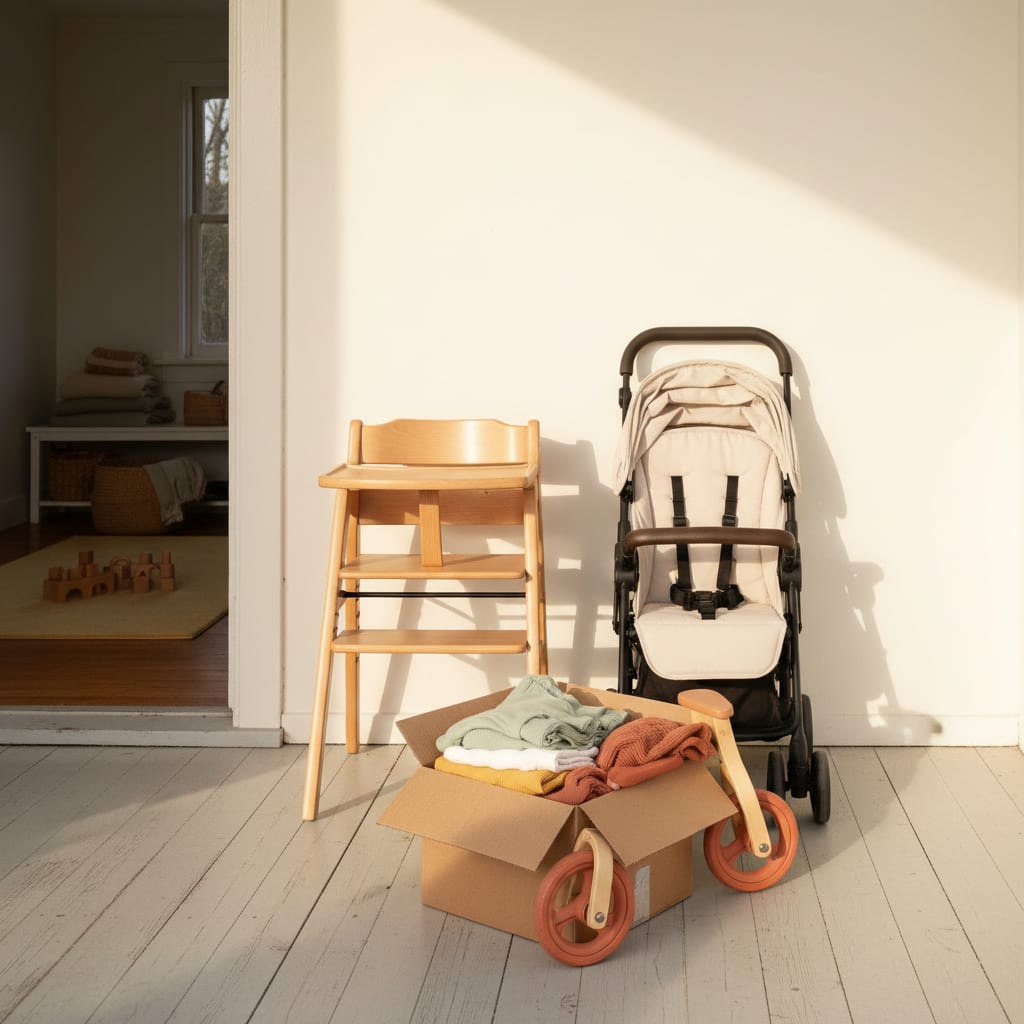
- Bulky gear. A high chair costs more to ship than it sells for. List it locally instead.
- Anything safety-critical you can’t vouch for. If you don’t know an item’s history, or it has been recalled, don’t sell it.
A naptime listing rhythm
Listing goes fastest in batches, so treat it as a weekly block rather than something you do in scraps.
- Sort during the day. Pull one size into a laundry basket while the kids play. Group it into lots of one season.
- Photograph at the start of nap. Daylight near a window, on a plain sheet or floor. Lay each lot out flat, then a close-up of tags and any flaws.
- List from your phone in the eBay app while the photos are fresh. Put size, season and piece count in the title, because that’s what buyers search for.
- Weigh while you’re there. Bag the lot and weigh it right away so your shipping cost is accurate. A digital shipping scale like the Accuteck 8250 saves you guessing and undercharging.
- Store each lot bagged and labeled with its listing title, so packing a sale takes two minutes.
One nap a week can comfortably get through a basket.
Shipping without the post office line
eBay’s Ship with eBay program is “currently available for individual sellers listing eligible items on eBay.com.” In its words: “No need to buy your own label - we’ll provide you with a prepaid shipping label.” Unless you’ve offered free shipping, “your buyer is charged for the shipping cost at checkout.”
Fashion is one of the eligible categories, which covers most kids’ clothing lots. You can print the label at home, or “show the QR code at the drop-off location,” which helps if you don’t own a printer. Auctions are excluded, and eBay drop-off locations take packages up to 25 lb.
For a home day, the drop-off fits easily into the weekly errand loop. A poly mailer and a QR code means no line and no printer.
Getting paid
eBay’s getting paid page says payouts go “directly to your checking account or Visa or Mastercard debit card.” You can’t use a savings or PayPal account. You can schedule “daily, weekly, biweekly, or monthly payouts,” and daily is the default. Payouts can be held if eBay finds a mismatch with the details you gave at registration, so set up your account carefully the first time.
If you sell regularly, keep a simple record of sales, fees and shipping costs, and ask a tax professional what applies to you.
What a realistic month looks like
Be honest with the numbers. A family clearing one closet might list eight or ten lots in a month, sell some quickly and reprice the rest. After fees and mailers, a $20 lot leaves you around $15. That’s grocery money, not income replacement, and it’s money that was sitting in a bin.
The bigger win is often space. A rhythm of one listing session and one drop-off a week keeps outgrown clothes moving out of the house as fast as the kids move up a size.
FAQ: selling on eBay
How much does eBay take from a sale?
For most categories, 13.6% of the total amount of the sale (including shipping and sales tax) plus $0.30 or $0.40 per order, according to eBay’s fees page on November 15, 2026. You also get 250 free listings a month.
Is it worth selling kids’ clothes on eBay?
Yes for size lots, brand-name pieces and outerwear. Usually not for single low-value basics, where the fee and shipping take most of the sale.
Who pays for shipping on eBay?
Unless you offer free shipping, the buyer pays at checkout. With Ship with eBay, eligible sellers get a prepaid label.
How do I get paid on eBay?
Payouts go to a checking account or a Visa or Mastercard debit card, on a daily schedule by default, or weekly, every two weeks or monthly if you choose.