How to Keep Night Feeds Boring (and Get Back to Bed)
The way to get through a 3am feed fast is to make it the most boring twenty minutes of your baby’s day. Keep the light as low as you can still see by, say almost nothing, skip the diaper change unless it’s dirty or soaked, feed, burp briefly and put them straight back down. Set everything up before you go to bed so you never turn on a main light or go hunting for wipes. And the one rule that isn’t about speed: if there’s any chance you’ll fall asleep, don’t feed on a couch or an armchair.
Why boring is the whole strategy
A baby who wakes to feed at night needs the milk. They don’t need the rest of what daytime comes with, and the rest is what turns a fifteen-minute feed into an hour awake.
The NHS frames it as teaching your baby that night is different from day, and its list for night-time is short and specific: keep the lights down low, don’t talk much and keep your voice quiet, put your baby down as soon as they’ve been fed and changed, don’t change them unless they need it, and don’t play with them. The NHS page on helping your baby sleep adds the daytime half: open the curtains, play, and don’t fuss about ordinary noise during day naps.
The American Academy of Pediatrics says the same in fewer words on its parent site: “Try not to stimulate or wake babies when you feed or change them during the night. If you speak, speak softly.”
So the contrast does the work. Daytime feeds can be chatty, bright and social. The 3am one should feel like nothing much happened.
Set the station up before you go to bed
Most of the stimulation in a night feed comes from the adult scrambling, not the baby. Ten minutes at 9pm fixes most of it.
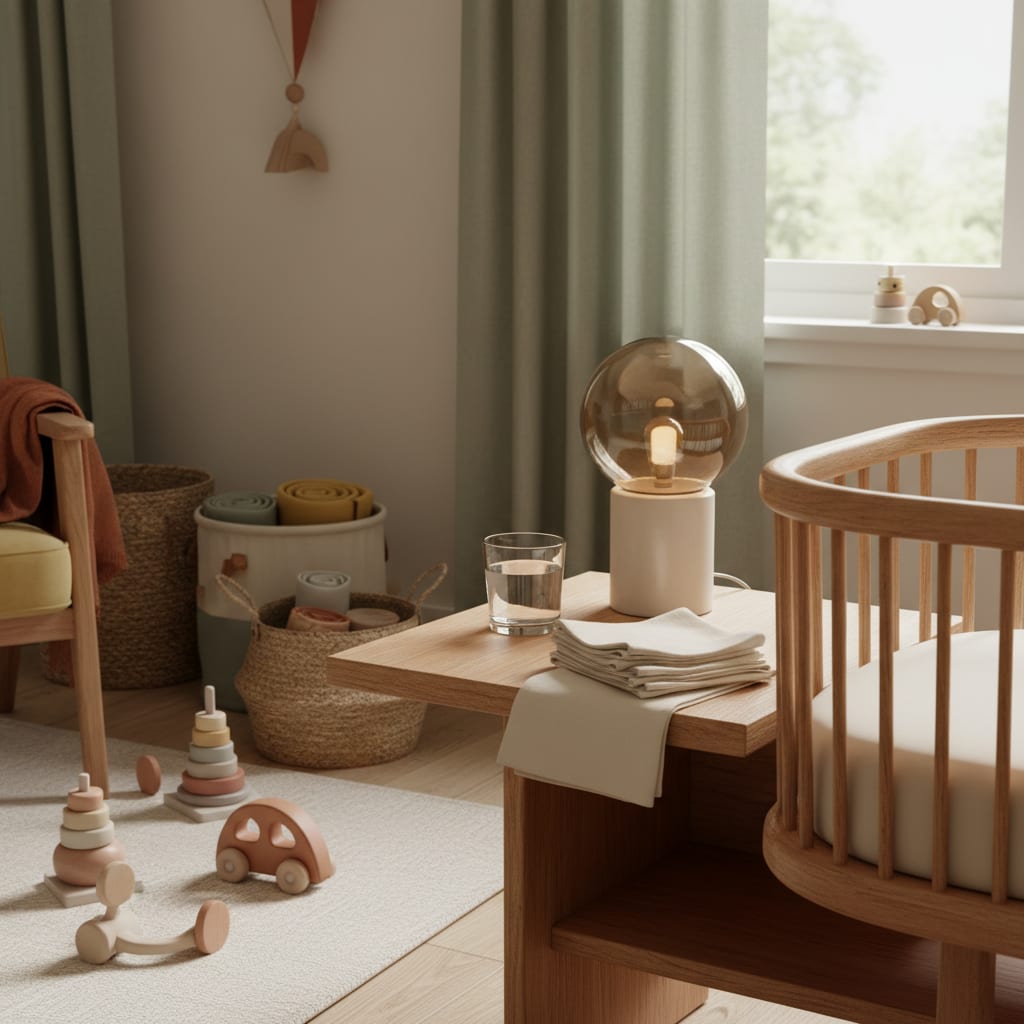
- One low, warm light. A plug-in night light near where you feed, low enough that you can see the latch or the bottle and not much else. A dim amber one like the GE SleepLite does the job. Leave the main light off all night.
- The change kit within arm’s reach. One diaper, wipes, a spare sleep sack, laid out where your hand lands in the dark.
- Your own kit. A glass of water, a burp cloth and whatever you need for the bottle or for nursing, all set out before you sleep.
- The phone face down. If you use it as a light, it’s brighter than you think and it pulls you awake too.
The script, start to finish
The whole aim is the same sequence every time, so neither of you is deciding anything at 3am.
- Go in without switching anything on. The night light is already on.
- Change first, but only if it’s needed. The NHS advice is not to change a baby at night unless they need it. A wet-but-not-soaked diaper can usually wait for morning. If they do need a change, doing it before the feed means the feed is the last thing that happens, and a baby who drifts off drowsy and full is easier to put down.
- Feed with as little conversation as you can. A quiet “shh” or one soft phrase you always use is plenty. Hold off on the eye-contact games and the songs; they’re for daytime.
- Burp briefly, upright on your shoulder, in the same low light.
- Straight back down, on their back, in their own crib or bassinet. If you’ve been working on fading out the rock to sleep, night wakings are deliberately the last place to change it, so do whatever gets them down tonight.
Whether they settle at once or take a minute, the room stays dark and the voice stays quiet. A baby who wakes up properly and finds a lit room, a chatting parent and a toy has every reason to stay up.
The safety rule that matters more than any of this
Being tired is part of every night feed, and the most dangerous place to be tired with a baby is a couch or an armchair. The NIH’s Safe to Sleep campaign is direct about it: if there’s any chance you might fall asleep while feeding, avoid feeding on couches and armchairs, because they “carry a very high risk for other sleep-related deaths from entrapment and suffocation.”
What the same page suggests instead:
- If you feed in your bed, clear pillows, blankets and loose bedding from your side first. If you fall asleep, put your baby back in their own sleep space, on their back, as soon as you wake.
- If another adult is up, they can wake you if you start to doze, or move the baby to their own sleep space for you.
- If you’re on your own, the page suggests setting a timer to go off every few minutes to keep you awake.
A nursery chair is still an armchair. If you’re nodding off in it, move the feed somewhere safer rather than trying harder to stay awake.
Night feeds in a house with a toddler too
On a home day, the 3am feed is never only about the baby. If you have an older one, the baby’s night decides whether you have anything left for the 6:30 start with a toddler who slept fine.
Two things help. First, split the night where you can. The NHS suggests that if you’re formula feeding, a partner can share the feeds, and if you’re breastfeeding, they can take over the early-morning changing and dressing so you get back to sleep. Second, plan the next day as a low day after a broken night, not as a normal one. The shift-style mornings in the toddler-and-baby schedule were built for exactly that kind of morning.
When boring isn’t the problem
A boring feed shortens the waking. It doesn’t decide how many wakings there are, and a few patterns are worth looking at separately.
The feed that seems to be about comfort rather than hunger. The NHS notes that for some babies aged 6 months to a year, night feeds may no longer be needed. That’s for your pediatrician to confirm, not something to guess at 3am. Once they’ve given the go-ahead, Betteroo’s guide to cutting night feeds down gradually sets out the slow version, which keeps the remaining feeds “dim, quiet, and brief” while they taper.
A late-evening feed you’d rather choose than wait for. Some parents move one feed to their own bedtime instead, lifting a sleeping baby for a drowsy feed before they turn in. Betteroo has a guide to how parents run that 10 or 11pm feed, and it’s the same low-light idea at a time that suits you.
The 3am feed that has crept to 5am. A feed at five can quietly become the start of the day. That’s a different problem, covered in the 5am wake-up.

FAQ: keeping night feeds boring
Should I change my baby’s diaper at every night feed?
No. The NHS advises not changing your baby at night unless they need it. Change a dirty diaper or a soaked one. A lightly wet one can usually wait until morning. If you do need to change, doing it before the feed lets the feed be the last thing that happens.
What kind of night light is best for night feeds?
A dim, warm-toned one that’s just bright enough to see the feed by. Many parents choose amber or red. Whatever you use, keep it low and keep the main light off.
Is it okay to talk to my baby during a night feed?
A soft word is fine. The AAP’s advice is that if you speak at night, you speak softly. What to skip is the daytime kind of talking: chatting, songs and play, which tell your baby it’s time to be up.
Is it safe to feed my baby in a glider or armchair at night?
Not if there’s any chance you’ll fall asleep. The NIH’s Safe to Sleep campaign warns against feeding on couches and armchairs for exactly that reason. If you’re likely to doze, feed in your own bed with the pillows and bedding cleared from your side, then put your baby back in their own sleep space.