Transcription Jobs for Beginners: The Honest Rate Math
Transcription jobs for beginners are real, easy to start, and pay less than the advertised rate — because the advertised rate is per audio minute, and a beginner spends several working minutes on each one. Rev publishes $0.40–$1.10 per audio minute for transcription; TranscribeMe publishes $15–$22 per audio hour and, to its credit, also publishes that average monthly earnings are $250. Convert those into hours of your actual life and the picture changes completely. Here’s that conversion, done properly, plus which platforms are worth your evenings and which aren’t.
First, the vocabulary that hides the pay cut
Three terms do all the damage:
- Audio hour — sixty minutes of recording. Not sixty minutes of your work.
- Per audio minute — the standard freelance transcription unit. Multiply by 60 to get the audio-hour rate.
- The ratio — how many minutes you spend per minute of audio. SideHusl, which reviews side-income platforms, puts the realistic spread at two to ten minutes of work per minute of audio, depending on audio quality, accents, number of speakers, and your typing speed.
A beginner on ordinary two-speaker audio is usually somewhere around 4:1 — four minutes of work per minute of recording — improving toward 2:1 or 3:1 with practice and better tooling. Everything below uses 4:1 as the beginner case and shows the improved case beside it, so you can see where the ceiling actually is.
The honest rate math, platform by platform
| Platform | Published rate | Per audio hour | At 4:1 (beginner) | At 2:1 (practiced) |
|---|---|---|---|---|
| Rev — transcription | $0.40–$1.10 / audio min | $24–$66 | $6–$16.50 /hr | $12–$33 /hr |
| Rev — captions | $0.54–$1.10 / audio min | $32.40–$66 | $8.10–$16.50 /hr | $16.20–$33 /hr |
| Rev — legal | $0.55–$2.00+ / audio min | $33–$120+ | $8.25–$30+ /hr | $16.50–$60+ /hr |
| TranscribeMe | $15–$22 / audio hr | $15–$22 | $3.75–$5.50 /hr | $7.50–$11 /hr |
| GoTranscript | up to $1.75 / min (stated max) | up to $105 | up to $26.25 /hr | up to $52.50 /hr |
| Scribie | $5–$20 / audio hr (reported) | $5–$20 | $1.25–$5 /hr | $2.50–$10 /hr |
The middle columns are arithmetic on published rates, not estimates of what you will earn. The last two columns are the same arithmetic applied to a work-speed assumption — treat them as a shape, not a promise, because your ratio is personal and audio quality swings it enormously.
Three things jump out of that table.
The floor is genuinely bad and the ceiling is genuinely fine. A beginner taking whatever low-rate files are available is working for single digits an hour. A practiced transcriptionist choosing better-paid files is in a normal remote-work range. Same platform, same person, six months apart.
Rev’s published rates are the most honest starting reference in the field, because they’re per audio minute with a stated floor and ceiling, and they’re paid weekly via PayPal for approved work. You can do the math before you apply.
Scribie is where I’d tell a friend not to start. SideHusl gives it their lowest rating and reports that although the site advertises $5–$20 per audio hour, transcribers say $5 is the standard — which at beginner speed lands near a dollar or two per working hour. That is not a job; it’s an unpaid apprenticeship with a PayPal button.
TranscribeMe deserves a fairer word than the raw numbers give it. Its rates are low, but it publishes them without spin — including that average monthly earnings figure of $250 and a stated top monthly figure of $2,200 — and its short files are the single most nap-compatible format in transcription. As a place to build speed on two-minute clips before applying somewhere better paid, it has a real use. As a destination, it doesn’t.
What the wider transcription market pays
The platforms above are the freelance-marketplace tier. The employed and specialist tiers are a different economy, and worth knowing about early so you’re aiming at something:
- Transcriptionist roles generally: Indeed reports an average of $26.44 an hour from 279 job postings over the past three years, with a $15.64–$44.69 spread. These are jobs, not marketplace gigs — you’re paid for time, not audio minutes.
- Medical records specialists, the category that absorbed most medical transcription work: median pay of $50,250 a year, or $24.16 an hour, in May 2024 per the Bureau of Labor Statistics.
- Court reporters and simultaneous captioners: BLS median of $67,310 a year, $32.36 an hour, in May 2024 — the best-paid destination on this ladder, with employment projected flat (0%) through 2034 and about 1,700 openings a year from turnover. It requires real training; it is not a from-home-this-week option.
The realistic arc, then: marketplace work to build speed and a track record, then either specialist niches (legal, medical, insurance) or direct clients who pay per project rather than per minute.
What the entrance test actually asks
Every platform on this page gates entry behind a test, and the pass rate is lower than people expect — not because the typing is hard, but because applicants skip the guidelines. What the tests check, in every case:
- Style-guide compliance. Each platform has rules about filler words, false starts, stutters, numbers, speaker labels and timestamps. Verbatim styles keep the “um”s; clean-read styles strip them. Getting this backwards fails you even if every word is correct.
- Speaker identification. Two or three voices, some overlap, and you must consistently attribute each line in the platform’s required format.
- Inaudible tagging. You’ll be given at least one genuinely unclear passage. The right answer is the platform’s inaudible tag with a timestamp — not a plausible guess. Guessing is the single most common fail.
- Basic grammar and punctuation. Where a sentence ends is your call, and it’s graded.
The fix is boring and works: read the entire style guide, then transcribe two minutes of a podcast against it before you open the real test. Failed tests often carry a waiting period before you can retry, so treat the first attempt as the only one.
Moving up: the niches that pay more
Beginner marketplace work is a floor, not a career. The four routes off it, roughly in order of how far they are from a standing start:
Captioning and subtitling. The nearest step up, and often available on the same platforms — Rev’s published caption rates start at $0.54 per audio minute against $0.40 for straight transcription. It requires learning timing and reading-speed conventions, which is a weekend of study rather than a course.
Insurance and law-enforcement transcription. Recorded statements and interviews, frequently with poor audio. It pays a premium precisely because the audio is bad, and the vocabulary is learnable on the job.
Legal transcription. The highest published marketplace rates here — Rev lists $0.55 to $2.00+ per audio minute for legal work. You need legal terminology and formatting conventions, and accuracy standards are unforgiving. It is also the gateway to transcript proofreading, which pays against court-reporting economics rather than marketplace ones.
Medical transcription. The most credential-gated of the four, and largely absorbed into the medical records field, where BLS reports a $50,250 median. Realistically this one requires formal training in medical terminology first — it’s a career change, not a next step.
Foreign-language transcription sits alongside all four: if you’re fluent in a second language, that alone moves you toward the top of the published rate bands on most platforms, because the supply of bilingual transcribers is thin.
Whether it fits your day
Transcription’s honest advantages for a home day are specific and worth naming:
Task supply is reliable. Unlike AI training work, where queues empty for days at a time, transcription marketplaces almost always have files. When you have a free block, there is something to do in it. For anyone who needs the work to be there rather than to pay the most, that’s a real advantage.
Files are short. Many marketplace files are minutes long by design. Finishing one inside a nap is normal.
It hires on a test, not a résumé. GoTranscript’s application is a guidelines review plus a short language test. That’s a genuine on-ramp for someone with an eight-year employment gap and no interest in explaining it.
And the honest disadvantages:
It needs quiet. Actual quiet, in your ears. This is not work you can do with a toddler narrating from the rug.
It is monotonous, and monotony has a cost. People underestimate how much focus transcription burns per dollar. If your only block is after bedtime, factor in that this is the least restorative way to spend it.
The beginner rate is genuinely low. Not “modest” — low. Anyone telling you otherwise is either selling a course or quoting audio-hour rates without doing the conversion.
The two pieces of equipment that change your ratio
Everything else is optional; these two move the number that determines your pay.
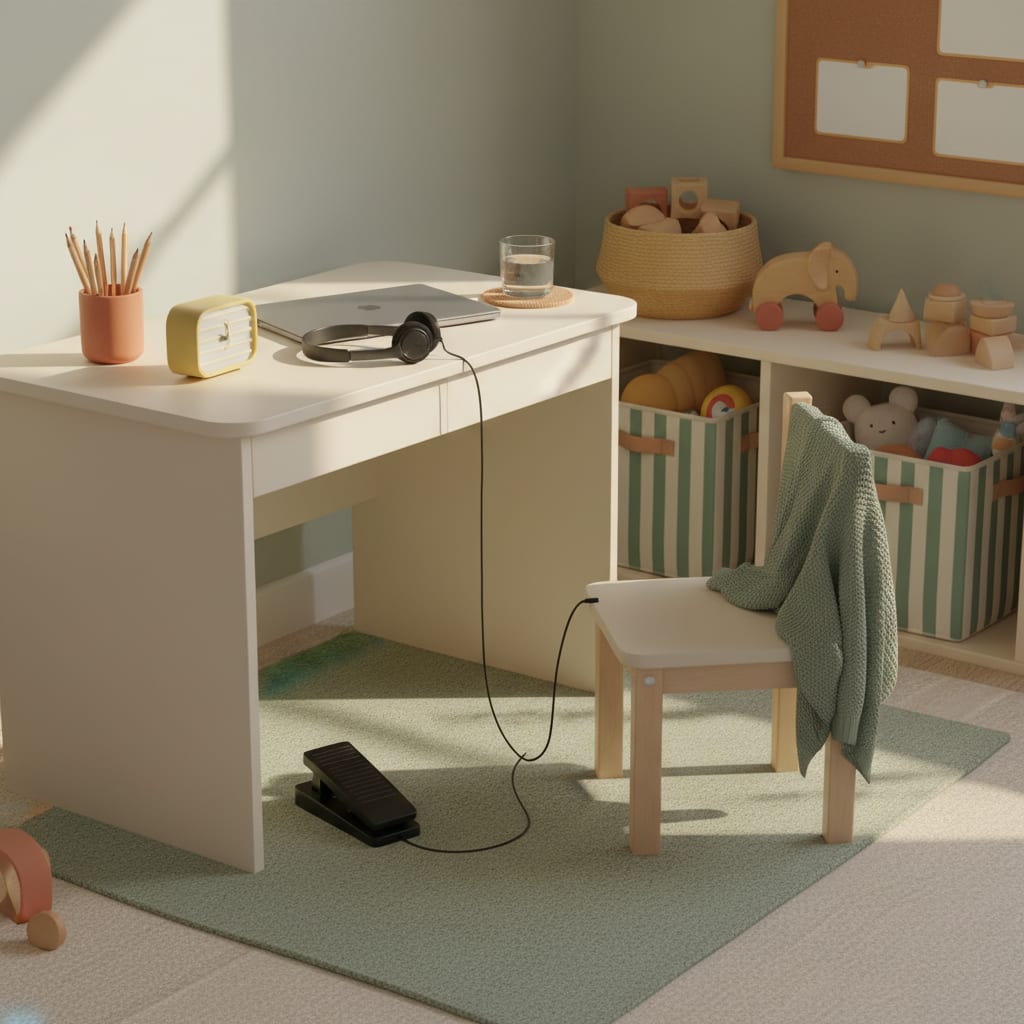
A USB foot pedal. Transcription speed is throttled by how often you take your hands off the keyboard to rewind. A pedal moves play, pause, and rewind to your foot, and it is the single biggest ratio improvement available. The long-standing standard is the Infinity IN-USB-2 foot control, which works with the common free transcription players. Buy it after your first paid file, not before — prove you like the work first.
A closed-back headset. Laptop speakers cost you rewinds on every mumbled word. A basic wired USB headset like the Logitech H390 is enough; this is not a category where spending more helps much.
Free transcription software (Express Scribe and oTranscribe are the usual first stops) handles the rest. Do not buy a course. Transcription style guides are published free by the platforms themselves, and the actual skill is built by transcribing.
A realistic first month
- Week one: test into two platforms. Rev for the published per-minute rates, TranscribeMe for short practice files. Read each style guide fully before your test — most failed applications are style-guide failures, not typing failures.
- Week two: time yourself honestly. Stopwatch on, three files, note your ratio. That single number tells you more than any review article.
- Week three: chase quality, not volume. Rejected or reworked files cost you double. Accuracy scores gate access to the better-paid files on every platform.
- Week four: do the division. Total earned divided by total minutes worked. Compare it against what the same hours would earn elsewhere — the block-by-block comparison in stay-at-home mom jobs is the honest yardstick.
If your real hourly number after a month is climbing toward double digits, transcription is working and specializing is the next move. If it’s stuck near the floor, you’ve learned something cheaply, and the skill transfers — careful listening and careful reading are the same muscle that proofreading work pays better for.
FAQ: transcription jobs for beginners
How much can a beginner transcriptionist actually make?
There’s no honest single figure, because pay is per audio minute and speed varies hugely. What can be said: published beginner rates run from Scribie’s reported $5 per audio hour up to Rev’s $0.40–$1.10 per audio minute, and at typical beginner speeds those convert to roughly single-digit hourly earnings, improving as your ratio does. TranscribeMe publishes that its average monthly earnings are $250 — a useful reality check on any bigger number you see quoted.
Do I need experience or certification to start?
No. Rev, TranscribeMe and GoTranscript all hire through their own entrance tests rather than credentials. Certification matters only in the specialist tiers — court reporting and captioning in particular, which BLS lists with a median of $67,310 a year and formal training requirements.
Which transcription site pays beginners best?
On published rates, Rev’s per-audio-minute structure has the highest realistic beginner ceiling, and its legal tier the highest of all. GoTranscript states a higher maximum, but it applies to specific languages and task types rather than general English audio. Scribie’s reported rates are low enough that SideHusl rates it their worst — start elsewhere.
Is transcription being replaced by AI?
Partly, and it shows in the market: much of the volume now flows through automatic transcription with humans editing the output rather than typing from scratch. That’s why captioning and review work exists on these platforms alongside straight transcription, and why the durable money is in the niches AI handles worst — poor audio, heavy accents, multiple speakers, legal and medical vocabulary.
Can I transcribe with kids in the house?
During naps and after bedtime, yes — the files are short and the work is stop-and-startable. During awake hours, no. Transcription runs entirely through your ears, and there’s no version of it that survives a running commentary about trucks.